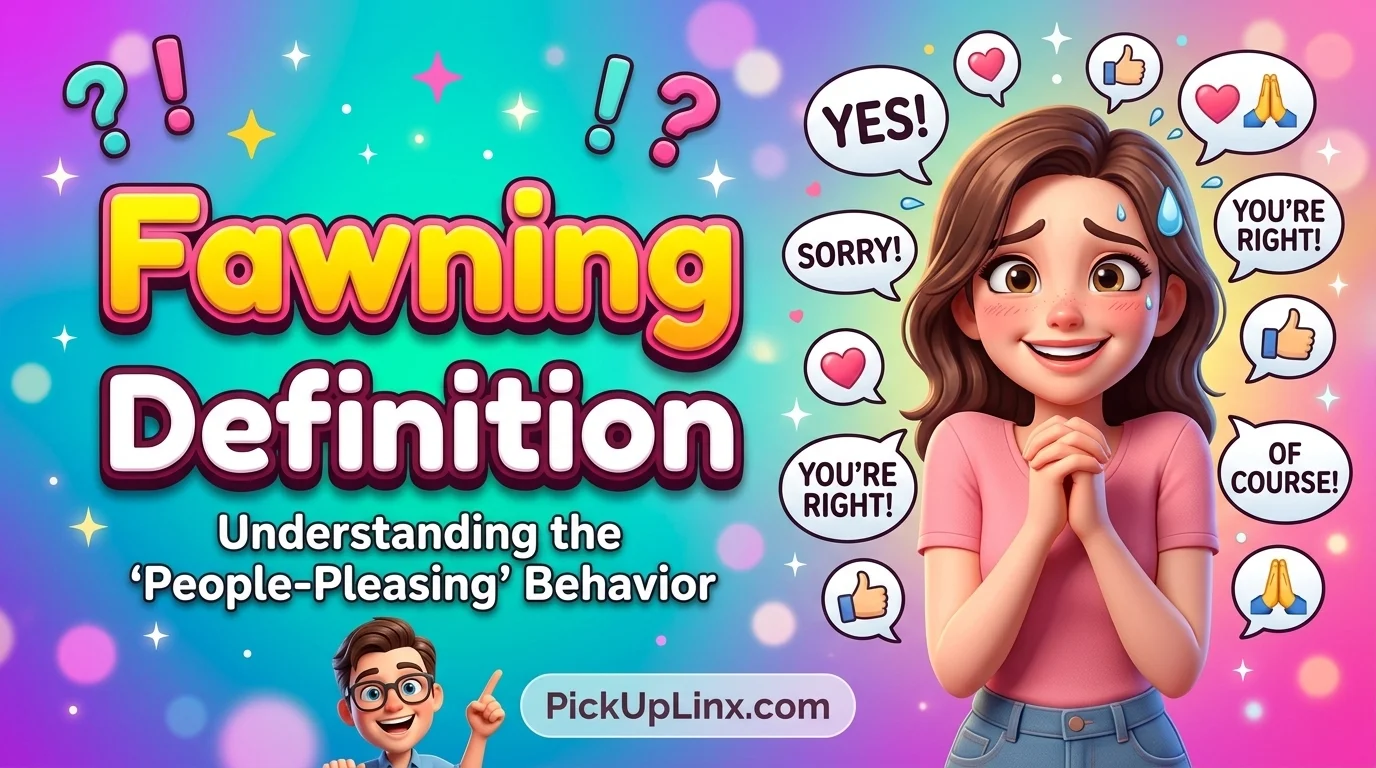
Fawning Definition means showing too much kindness, praise, or agreement to gain someone’s approval or avoid conflict. In everyday English, it often describes behavior that seems overly eager or flattering. In psychology, the term has a deeper meaning.
The fawn response is a way some people react to fear, stress, or a sense of danger by trying to please others. They may hide their own needs to keep someone else happy or prevent anger.
Understanding the fawning definition can help you recognize this behavior, see why it happens, and learn how healthy boundaries support better relationships.
1. What Is the Fawning Definition?
The word fawning means acting in an overly eager, pleasing, or flattering way toward another person. Someone who fawns may give too much praise, agree with every opinion, or try hard to win another person’s favor.
In everyday use, the word often has a negative tone. It can suggest that a person is trying to gain approval rather than speaking honestly.
For example, imagine an employee who praises every idea their boss shares, even when they disagree. They may laugh at every joke and never express a different view. A person watching this behavior might describe the employee as fawning over the boss.
The word also has a meaning in psychology. The fawn response describes a pattern in which a person tries to please, calm, or satisfy someone they fear. They may do this to feel safer or reduce the risk of conflict.
These two meanings are related, but they are not always the same. A person can flatter someone to gain a reward without feeling afraid. A person using a fawn response may be trying to protect themselves from a threat.
The meaning depends on the situation and the reason behind the behavior.
2. What Does Fawning Mean in Everyday English?
In everyday English, fawning describes excessive praise, attention, or agreement. It often suggests that a person is trying too hard to impress someone.
A person may act this way around a manager, a popular friend, a teacher, or someone with power. They might hope to gain a favor, avoid criticism, or become part of a group.
For example, a student may tell a teacher that every lesson is perfect, even when the student does not believe it. If the praise seems forced and is meant to gain approval, it may be called fawning.
Here are some common examples of fawning behavior:
- Giving someone far more praise than the situation calls for
- Agreeing with a person just to stay on their good side
- Laughing at jokes that are not funny to you
- Offering help mainly to gain approval
- Acting as if someone can do no wrong
- Ignoring your own views to please another person
However, being kind is not the same as fawning. A sincere compliment can be honest and healthy. Helping a friend can show care and respect.
The key difference is the pattern and purpose. Fawning often involves excessive approval-seeking, while genuine kindness allows people to express their own thoughts and needs.
3. What Is the Fawn Response in Psychology?
In psychology, the fawn response is a term used to describe a way some people respond to a threat by trying to please the person they fear.
People often hear about the fight, flight, and freeze responses. These are common ways the body and mind may react to danger. The term fawn is also used to describe people-pleasing behavior that can develop as a way to cope with fear or unsafe relationships.
A person using this response may try to keep others calm. They might agree, apologize, offer help, or hide their feelings to reduce the chance of anger or harm.
For example, a person who grew up around frequent shouting may learn to watch other people’s moods very closely. As an adult, they might say yes to every request because they worry that saying no will lead to an argument.
This behavior may feel automatic. The person may not stop to ask what they want because their main goal is to keep the situation peaceful.
The fawn response is not a formal diagnosis on its own. It is a descriptive term used in some discussions of trauma, stress, and coping. Not every people-pleasing habit comes from trauma, and only a qualified professional can assess an individual’s mental health concerns.
4. Common Signs of Fawning Behavior
Fawning can look different from one person to another. Some people notice it in their words, while others see it in the choices they make.
A common sign is difficulty saying no. A person may agree to a task even when they are tired, busy, or uncomfortable. They may fear that refusal will upset someone or damage the relationship.
Another sign is hiding personal feelings. Someone may pretend to agree with a partner or friend because they think honesty will cause conflict.
Other signs can include:
- Apologizing even when you have done nothing wrong
- Feeling responsible for everyone else’s emotions
- Changing your opinions to match the people around you
- Saying yes when you really want to say no
- Feeling uneasy when someone seems disappointed
- Giving too much time or help to earn approval
- Struggling to ask for support
- Watching other people’s moods to avoid upsetting them
Consider this example. Sara is exhausted after a long day at work. Her friend asks her to help with a task that will take several hours. Sara wants to rest, but she agrees because she fears her friend will stop liking her if she refuses.
One example alone does not prove that Sara is fawning. People sometimes help others even when it is inconvenient. The concern arises when the behavior becomes a repeated pattern that harms their well-being or prevents them from making free choices.
5. Why Do People Develop Fawning Habits?
There is no single reason why someone may develop fawning habits. The behavior can be shaped by family life, past experiences, social pressure, or fear of rejection.
Past experiences may play a role. A person who faced anger, bullying, harsh punishment, or unpredictable reactions may learn to keep others happy to avoid trouble.
Fear of rejection can also lead to people-pleasing. Someone may believe that disagreement will cause others to leave or stop caring about them.
Low self-worth may make approval feel like proof that a person matters. They may depend on praise from others because they struggle to trust their own value.
Power differences can also affect behavior. A worker may feel unable to disagree with a manager who controls their hours or income. A child may try to please an adult because they depend on that adult for safety and care.
Other factors may include:
- Growing up in a home where conflict felt unsafe
- Being expected to care for other people’s feelings
- Experiencing controlling or harmful relationships
- Learning that personal needs are less important than others’ needs
- Feeling pressure to fit into a group
These experiences do not affect everyone in the same way. Some people become more cautious, while others learn to speak up or seek support.
It is also important not to assume that every polite or helpful person has a history of trauma. The reasons behind behavior are personal and can be complex.
6. Fawning vs. Kindness, People-Pleasing, and Flattery
Fawning can be confused with several other behaviors. Understanding the differences can make the term easier to use correctly.
| Behavior | Meaning | Example |
|---|---|---|
| Fawning | Excessive pleasing or flattering; in psychology, it may be linked to fear | Agreeing because you fear someone’s anger |
| Kindness | Caring about others while respecting yourself | Helping a friend when you have time |
| People-pleasing | Often putting others’ approval ahead of your own needs | Saying yes because you fear disappointing someone |
| Flattery | Giving praise, sometimes to gain favor | Praising a manager to get a benefit |
| Respect | Treating others with care while keeping your own views | Disagreeing politely during a discussion |
| Compromise | Finding a solution that considers both sides | Sharing tasks in a fair way |
These behaviors can overlap. For example, people-pleasing may be part of a fawn response, but the two terms are not exact synonyms in every context.
The main difference is that healthy kindness leaves room for choice. You can care about another person and still say no. You can respect a manager without praising every decision. You can love a partner without hiding all your feelings.
Fawning becomes more concerning when a person feels unable to choose freely because they fear what might happen if they do not please someone.
7. Examples of Fawning in Relationships and Daily Life
Fawning may appear in many settings. The details can differ, but the pattern often involves putting another person’s reactions ahead of your own needs.
In romantic relationships: One partner may agree to everything to prevent an argument. They may hide hurt feelings or take blame for every problem, even when both people share responsibility.
Example: Alex wants to spend a weekend with family. Their partner dislikes the idea, so Alex cancels the visit without discussing their own wishes.
At work: An employee may avoid giving honest feedback because they fear a manager’s response.
Example: Nina notices a mistake in a work plan but stays quiet. She worries that pointing it out will make her manager dislike her.
In friendships: A person may accept every invitation, lend money they cannot afford to lose, or change plans to keep a friend happy.
Example: Omar agrees to lend his friend money even though he needs it for rent. He fears the friend will end the friendship if he refuses.
In family life: An adult may feel responsible for keeping every family member calm. They may avoid normal disagreements and take on too many duties.
These examples show possible patterns, not proof of a psychological response. The important questions are whether the person feels free to choose, whether fear drives the behavior, and whether the pattern causes harm.
8. How Can Fawning Affect Mental Health and Relationships?
Fawning may help someone avoid conflict in the short term. However, a repeated pattern of ignoring personal needs can create problems over time.
A person may feel tired because they spend so much energy trying to keep others happy. They may struggle to know what they truly want because they are used to checking everyone else’s wishes first.
This can lead to stress, resentment, and emotional exhaustion. A person may also feel anxious when someone seems upset, even when the situation is not their responsibility.
Relationships can suffer, too. If one person always agrees, the other may not understand their real needs. Important problems may remain hidden until frustration builds.
Possible effects include:
- Trouble setting limits
- Feeling guilty after saying no
- Fear of disagreement
- Weak trust in personal choices
- Unfair or one-sided relationships
- Difficulty expressing anger or sadness
- Feeling valued only when being helpful
Fawning does not mean a person is weak. It may be a learned way of coping with situations that once felt unsafe. In some settings, trying to calm another person can be a practical way to reduce immediate danger.
The goal is not to blame someone for their response. It is to help them notice the pattern and find safer ways to express their needs when circumstances allow.
If a relationship involves threats, control, or violence, personal safety matters more than trying to communicate perfectly. Support from a trusted person or a local service may help.
9. How to Recognize and Change Fawning Patterns
Changing a long-standing habit can take time. A useful first step is to notice when you agree out of fear rather than choice.
Ask yourself: Do I really want to do this, or am I afraid of how the other person will react? You do not need to answer perfectly. The goal is to become more aware of your own feelings.
Try these steps:
- Pause before agreeing. Give yourself time to think before accepting a request.
- Name your feelings. Notice when you feel scared, guilty, tired, or pressured.
- Practice small boundaries. Start with a low-risk situation where saying no feels manageable.
- Use clear words. Try saying, “I can’t help today,” or “I need time to think.”
- Allow different opinions. Remind yourself that people can disagree and still care about each other.
- Notice healthy relationships. Spend time with people who respect your choices and limits.
- Seek support if needed. A mental health professional can help you explore patterns linked to fear or past harm.
For example, instead of agreeing to an extra task right away, you might say, “Let me check my schedule and get back to you.” This gives you time to decide without making an instant promise.
At first, setting boundaries may feel uncomfortable. That does not mean you are doing something wrong. It can take practice to learn that your needs matter, too.
If the behavior is linked to trauma, therapy may help you understand your reactions and build safer coping skills. Change should happen at a pace that feels manageable, especially if you are dealing with a controlling person.
10. When Should You Seek Professional Support?
Occasional people-pleasing is common. You may agree to help someone because you care about them, or you may stay quiet during a small disagreement to keep the peace. These choices are not always harmful.
Consider seeking support when the pattern becomes hard to control or affects your daily life. You may feel unable to say no, worry constantly about others’ reactions, or remain in relationships that leave you feeling unsafe.
A qualified mental health professional can help you explore the reasons behind these habits. They may teach skills for setting boundaries, managing anxiety, understanding emotions, and responding to conflict.
You do not need to prove that you have trauma to ask for help. Support can be useful even if you are unsure why you act this way.
It can also help to talk with someone you trust. Choose a person who listens without pressuring you to make choices before you feel ready.
If you face threats or abuse, seek help from a safe person or local support service. Do not feel that you must confront someone directly if doing so could put you at risk.
The aim is not to stop caring about other people. It is to build relationships where care goes both ways and you can express your needs without constant fear.
People Also Ask About Fawning Definition
1. What does fawning mean in simple words?
Fawning means trying too hard to please, flatter, or agree with someone. In psychology, it can describe a response in which a person tries to please someone they fear to feel safer.
2. What is an example of fawning?
A person may agree to do a task they cannot manage because they fear another person’s anger. They may hide their true feelings to avoid conflict or rejection.
3. Is fawning a trauma response?
The fawn response is often discussed in relation to trauma and unsafe experiences. However, the term is descriptive rather than a formal mental health diagnosis, and not all people-pleasing comes from trauma.
4. What is the difference between fawning and being nice?
Being nice can come from genuine care and free choice. Fawning often involves excessive pleasing driven by fear, pressure, or a strong need for approval.
5. Is fawning the same as people-pleasing?
The terms overlap but are not identical. People-pleasing means often putting others’ approval first, while fawning is commonly used for pleasing behavior linked to a sense of threat or fear.
6. Can a person stop fawning?
Yes, people can learn healthier ways to respond. Recognizing triggers, practicing boundaries, building self-trust, and seeking professional support may help over time.
7. Is fawning always a bad thing?
Not every act of pleasing someone is harmful. Trying to calm a tense situation may sometimes be useful. It becomes a concern when fear repeatedly stops a person from making free choices or caring for their own needs.
Conclusion
The fawning definition includes excessive pleasing, praise, or agreement to gain approval. In psychology, the fawn response describes a pattern in which someone tries to please another person to reduce fear or feel safer. While kindness and compromise are healthy parts of relationships, hiding your needs all the time can lead to stress and resentment.
Learning to recognize the pattern, set safe boundaries, and seek support can help people build stronger relationships. The goal is not to stop caring about others, but to make room for your own feelings, choices, and well-being.

Julian Lovett – A passionate writer who shares charming pickup lines, romantic ideas, and fun love content to help people spark connections and smiles. ❤️