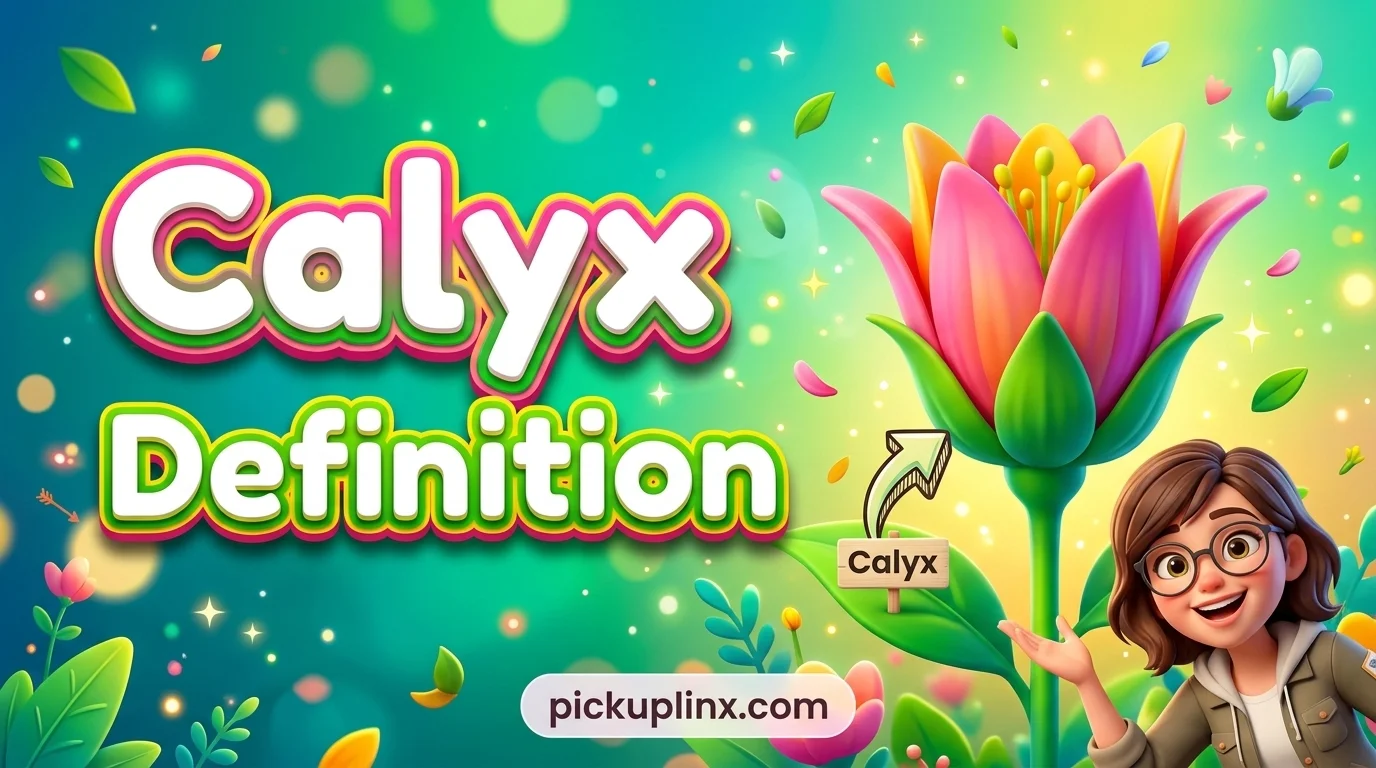
A Calyx Definition is the outer part of a flower, made up of small leaf-like structures called sepals. It sits below the petals and often looks green, though its color can vary. The main job of the calyx is to protect a flower while it is still a bud. Once the flower opens, the sepals may remain around its base or fall away.
The word “calyx” is used in botany, the study of plants. Learning the calyx definition helps students understand flower structure, plant growth, and how different parts work together.
1. What Is the Calyx Definition?
The word calyx means the group of sepals that forms the outermost floral whorl of a flower. A whorl is a ring of plant parts arranged around the same center. The calyx lies outside the petals and surrounds the inner parts of the flower.
Each sepal is usually small and leaf-like. In many flowers, sepals are green because they contain chlorophyll, the substance that helps plants use sunlight to make food. However, some sepals have bright colors and may look much like petals.
The calyx has an important role in flower development. It protects the young flower before it opens. It can also help support the flower after it blooms.
Example: In a rose, the small green parts beneath the petals are sepals. Together, these sepals form the calyx.
In simple words, the calyx is the flower’s outer protective layer. It helps keep the developing flower safe and forms an important part of its structure.
2. What Is a Calyx in Botany?
In botany, the calyx is one of the four main floral parts found in a typical flower. These parts are arranged in layers, starting from the outside and moving inward.
The four main floral parts are:
- Calyx: The outer ring of sepals.
- Corolla: The group of petals.
- Androecium: The male reproductive parts, usually made up of stamens.
- Gynoecium: The female reproductive part, made up of one or more carpels.
Each part has its own structure and role. The calyx protects the flower bud. The corolla often helps attract pollinators, such as bees and butterflies. The stamens produce pollen, while the carpels contain the ovules and form the fruit after fertilization in many flowering plants.
These parts work together to support the plant’s reproductive process.
Not every flower has all four parts in a clear or complete form. Some flowers have reduced or missing parts. Botanists study these differences to identify plants and understand how flowers have evolved.
The calyx is often easy to spot because it forms a ring beneath the petals.
3. What Are the Main Functions of a Calyx?
The calyx does more than form the outer layer of a flower. It helps protect and support the flower during different stages of growth.
Protecting the flower bud
Before a flower opens, its petals and reproductive parts are delicate. The sepals surround the bud and help shield it from minor physical damage. They may also help reduce exposure to harsh conditions.
Supporting the open flower
In many plants, the calyx remains attached after the petals open. It helps support the base of the flower and keeps the floral parts connected to the stem.
Taking part in photosynthesis
Green sepals can contain chlorophyll. This means they may carry out photosynthesis and help the plant make sugars using sunlight, water, and carbon dioxide.
Helping with seed and fruit development
In some plants, the calyx remains attached as the fruit grows. It may protect or support the developing fruit. In other plants, the sepals dry up or fall off soon after flowering.
The exact role of the calyx depends on the plant species. Its most widely recognized function is protecting the flower during the bud stage.
4. What Are Sepals, and How Do They Form a Calyx?
Sepals are the individual parts that make up the calyx. Each sepal is a separate floral structure, while the calyx refers to all the sepals taken together.
Think of a flower as having several outer pieces that form a protective ring. One piece is a sepal. The complete ring of those pieces is the calyx.
Sepals often look like small green leaves. They may have veins and a firm surface. Their shape and size vary from one plant to another.
Some flowers have sepals that are separate from one another. In other flowers, the sepals join together at the base or along much of their length.
For example, a hibiscus flower has a group of green sepals around the base of its flower. These sepals form the calyx and help protect the developing bud.
In some plants, the sepals look so much like petals that they can be hard to tell apart. Their position and structure help botanists identify them.
5. Types of Calyx in Flowers
Botanists describe different types of calyx based on how the sepals are arranged and whether they are joined together.
Polysepalous calyx
A polysepalous calyx has sepals that are separate from one another. Each sepal can often be seen as an individual part.
For example, many mustard-family flowers have separate sepals.
Gamosepalous calyx
A gamosepalous calyx has sepals that are joined together, at least at their bases. They may form a tube, cup, or bell-like shape.
Petunias are an example of flowers with a calyx made of joined sepals.
Persistent calyx
A persistent calyx remains attached after the flower has bloomed. It may stay on the fruit as it develops.
Tomatoes often retain their green, star-shaped calyx around the base of the fruit.
Deciduous calyx
A deciduous calyx falls off during or soon after flowering. The sepals do not remain attached to the mature fruit.
These terms help describe flower structure in plant science. They are also useful when comparing species.
6. Calyx vs. Corolla: What Is the Difference?
The calyx and corolla are two different parts of a flower. Both form outer layers around the reproductive structures, but they differ in position and common appearance.
The calyx lies outside the corolla. It is made up of sepals, while the corolla is made up of petals.
| Feature | Calyx | Corolla |
|---|---|---|
| Main parts | Sepals | Petals |
| Position | Outermost floral whorl | Inside the calyx |
| Common color | Often green | Often bright or colorful |
| Main role | Protects the flower bud | Often attracts pollinators |
| After flowering | May remain or fall off | May remain briefly or fall off |
The color difference is common, but it is not a strict rule. Some sepals are colorful, and some petals are green.
Example: In a rose, the green structures beneath the petals form the calyx. The soft, colorful structures that make up the visible bloom form the corolla.
Knowing the difference between these parts makes it easier to describe a flower correctly.
7. Examples of a Calyx in Common Plants
The calyx can be seen in many plants, including flowers, vegetables, and fruit-bearing species. Its shape and appearance depend on the type of plant.
Rose: The green, pointed sepals sit beneath the petals. They help protect the flower bud before it opens.
Hibiscus: Several sepals form a cup-like layer around the base of the flower. They protect the bud during early growth.
Tomato: The small green, star-shaped structure often remains attached to the fruit. It is the persistent calyx.
Strawberry: The green leafy parts at the top of the fruit are the sepals. They remain visible as the fruit develops.
Eggplant: The green, often spiny calyx surrounds the base of the fruit and remains attached as the fruit grows.
These examples show that the calyx does not always look the same. It may be small and simple, form a cup, or remain visible on a mature fruit.
When studying a flower, look below the petals and around the base. You may find the sepals forming the calyx.
8. What Is the Calyx in Fruit-Bearing Plants?
In many fruit-bearing plants, the calyx plays a role beyond the flowering stage. It may remain attached as the ovary develops into a fruit.
After pollination and fertilization, the ovary of many flowering plants grows and develops into the fruit. The sepals may stay in place during this process.
A tomato is a familiar example. Its green calyx often remains attached at the top of the fruit. Strawberry sepals also remain visible around the fruit’s top.
In other plants, the calyx may dry up, shrink, or fall away. Some flowers have sepals that remain attached but no longer perform a major protective role.
It is important to understand that the calyx does not produce the fruit itself. The fruit usually develops from the flower’s ovary. The calyx is a separate floral structure that may continue to support or surround it.
This difference helps students understand the relationship between flower parts and fruit formation.
9. How to Identify a Calyx in a Flower
You can often identify the calyx by looking carefully at the outside of a flower. You do not need special tools to study a common flower, although a magnifying glass can help you see small details.
Follow these steps:
- Find the petals. Look for the colorful or noticeable parts of the flower.
- Look beneath them. Search for small leaf-like structures around the flower’s base.
- Check their shape. Sepals often look like tiny leaves or pointed green pieces.
- Count the sepals. Some flowers have three, four, or five sepals, while others have different numbers.
- Look at a closed bud. The sepals may be easier to see before the petals open.
- Compare several flowers. Different species have different calyx shapes and arrangements.
For a simple classroom activity, observe a rose, hibiscus, or tomato flower. Draw the flower and label the sepals, calyx, petals, and stem.
Avoid pulling apart a flower if you need it for later study. A photograph can also help you compare the structures without damaging the plant.
10. Why Is the Calyx Important in Plant Studies?
The calyx is important because it helps botanists describe and identify flowering plants. Differences in the number, shape, size, and arrangement of sepals can provide clues about a plant’s identity.
Students also study the calyx to learn how flowers are organized. By comparing the calyx with the corolla and reproductive parts, they can understand how each structure contributes to the flower’s development.
The calyx also helps explain how plants protect young flowers. Before a bud opens, the petals and reproductive structures need protection as they develop. The sepals provide an outer layer around these delicate parts.
In agriculture, observing the calyx can help people recognize different fruits and flowering crops. For example, the persistent calyx of a tomato or strawberry is easy to see during fruit growth.
The calyx is also useful in botanical descriptions and plant identification guides. Scientists may record whether sepals are separate or joined, whether they remain after flowering, and what shape they form.
Although it is often less colorful than the petals, the calyx is an important part of flower structure.
People Also Ask About Calyx Definition
1. What is a calyx in simple words?
A calyx is the outer part of a flower made up of sepals. It usually protects the flower while it is still a bud.
2. What is the main function of a calyx?
Its main function is to protect the developing flower bud. Green sepals may also carry out photosynthesis, and the calyx may remain attached as the fruit grows.
3. What is the difference between a calyx and a sepal?
A sepal is one individual part of the flower’s outer layer. The calyx is the complete group of sepals.
4. Is a calyx always green?
No. Many calyces are green, but some have bright colors. In certain flowers, the sepals look similar to the petals.
5. What is an example of a calyx?
A rose has green sepals beneath its petals. A tomato also has a visible green calyx that often remains attached to the fruit.
6. What is a persistent calyx?
A persistent calyx stays attached after flowering. For example, the green star-shaped calyx often remains at the top of a tomato.
7. Is the calyx the male or female part of a flower?
Neither. The calyx is a non-reproductive floral part made of sepals. The stamens are the male reproductive parts, while the carpels form the female reproductive part.
Conclusion
The calyx is the outer floral whorl made up of sepals. It helps protect the flower bud and may support the flower or remain attached as fruit develops. Its shape, color, and arrangement vary among plant species.
Understanding the calyx definition makes it easier to learn flower anatomy, compare plants, and identify common flowers and fruits. Whether you study a rose, hibiscus, tomato, or strawberry, the calyx offers a simple way to explore how flowering plants grow and reproduce.

Julian Lovett – A passionate writer who shares charming pickup lines, romantic ideas, and fun love content to help people spark connections and smiles. ❤️