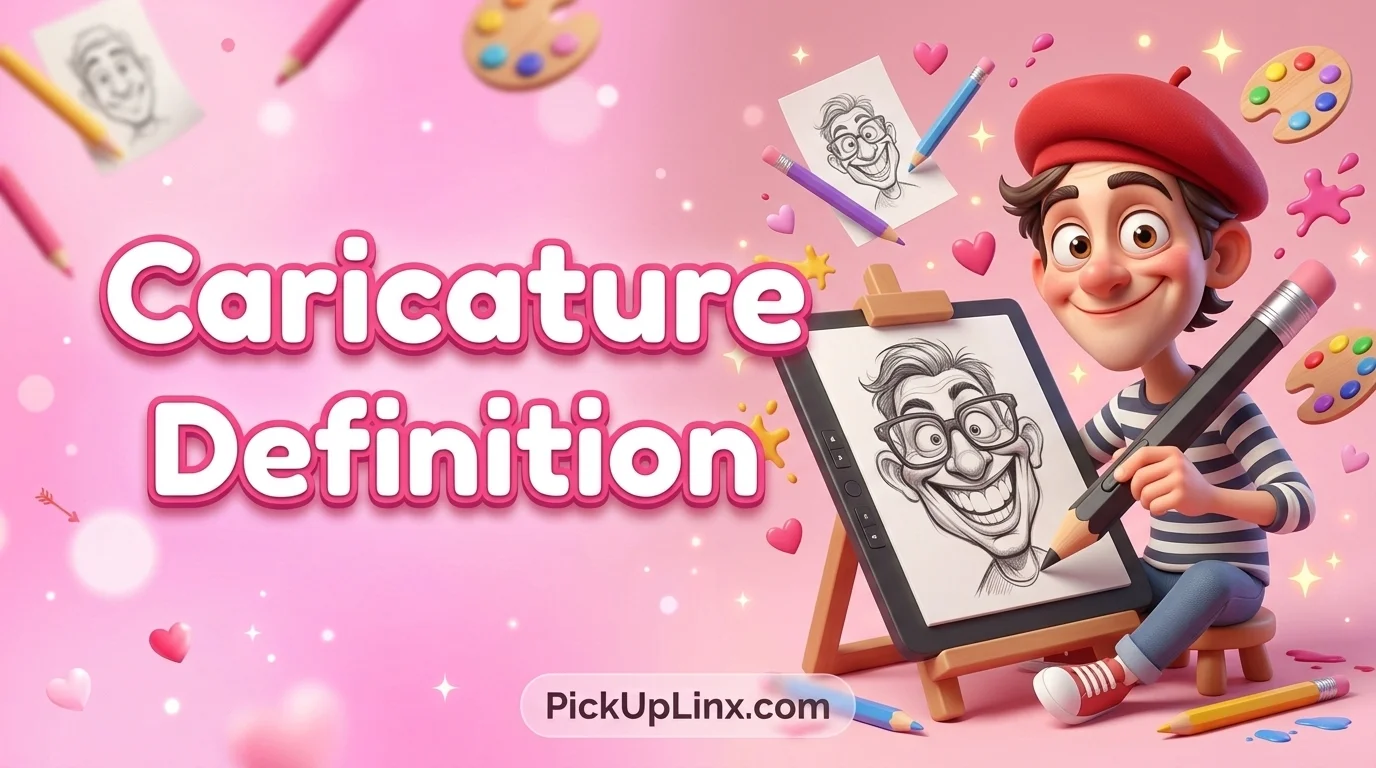
A Caricature Definition is a drawing, picture, or written description that makes certain features of a person or thing look bigger, smaller, or more noticeable than they are. Artists often use this style to show humor, share an opinion, or make someone easy to recognize. A caricature may show a person with a large nose, a wide smile, or a funny facial expression.
It can also appear in cartoons, books, newspapers, and political art. The goal is not always to make fun of someone. Caricatures can entertain, tell stories, and help people see familiar subjects in new ways.
1. What Is the Caricature Definition?
The word caricature means an exaggerated picture, description, or imitation of a person, group, or thing. It highlights certain features to make the subject look funny, unusual, or easy to recognize.
In art, a caricature often shows a person’s face or body with changed proportions. An artist may draw large eyes, a long chin, or a very wide smile. These details are made bigger on purpose.
In writing, a caricature can describe a person by focusing on a few strong traits. For example, a story might show a boss who cares only about money and never listens to workers. This description may exaggerate the boss’s behavior to make a point.
Caricatures can be playful, critical, or even harsh. Their meaning depends on how they are made and why they are used.
Simple example: An artist draws a famous singer with huge sunglasses and a hairstyle twice its normal size. The result is a caricature because it makes familiar features more noticeable for effect.
The main idea is exaggeration. A caricature changes or stresses certain details instead of showing every feature in a fully realistic way.
2. What Is the Purpose of a Caricature?
Caricatures serve several purposes. They can make people laugh, express an opinion, or help an audience recognize a person quickly.
One common purpose is humor. An artist may exaggerate a person’s hairstyle, smile, or posture to create a funny image. At fairs and public events, caricature artists often draw quick portraits for visitors.
Another purpose is social commentary. Artists may use caricatures to point out problems in society, such as greed, unfair rules, or the misuse of power.
Caricatures also appear in politics. A cartoonist might draw a public leader with an oversized crown to suggest that the leader wants too much control. The image expresses an opinion through visual humor.
In books and stories, writers may use caricature to make a character’s behavior stand out. A character who complains about every small problem may be shown as an exaggerated example of a constant complainer.
Common purposes include:
- Making people laugh
- Showing a person’s most noticeable traits
- Sharing political or social views
- Making characters memorable
- Encouraging people to think about an issue
A caricature does not always aim to insult its subject. It can be a friendly joke or a creative way to celebrate a person’s unique appearance.
3. Main Features of a Caricature
A caricature has several features that help set it apart from a realistic portrait.
Exaggeration is the most important feature. The artist changes certain details to make them stand out. A small feature may become large, or a normal expression may become more dramatic.
Recognition is also important. Even when the proportions look unusual, viewers should often be able to identify the subject. An artist may focus on a person’s familiar hairstyle, nose, glasses, or smile.
Selective detail means the artist chooses only a few features to emphasize. The drawing does not need to show every small detail of the face or body.
Expression can add humor or emotion. Raised eyebrows, a wide grin, or a dramatic frown can make a caricature more engaging.
Personal style also matters. Some artists use simple lines and basic shapes. Others add color, texture, and detailed backgrounds.
For example, imagine a teacher known for wearing round glasses and raising one eyebrow when asking a question. A caricature might make the glasses enormous and the raised eyebrow very high. Those two details could be enough to make the teacher recognizable.
A successful caricature balances exaggeration with identity. If every feature changes too much, the viewer may no longer know who or what the picture represents.
4. Different Types of Caricatures
Caricatures come in many forms. Their style depends on the subject, the artist’s goal, and the way the image will be used.
Portrait Caricatures
These focus on a person’s face or body. They often appear at parties, festivals, and tourist attractions. The artist may make the head larger than the body or exaggerate the person’s most noticeable features.
Political Caricatures
These use exaggerated images to comment on political leaders, parties, policies, or public events. They often appear in newspapers, magazines, and online publications.
Read more [Subrogation Definition]
Social Caricatures
These highlight habits, attitudes, or social problems. An artist might show a person who spends every moment looking at a phone to comment on excessive screen use.
Literary Caricatures
These appear in books, plays, and written stories. A writer may exaggerate a character’s behavior to make that person seem foolish, selfish, proud, or overly strict.
Digital Caricatures
These are made with drawing software, tablets, or other digital tools. Artists may create them for profile pictures, gifts, websites, or social media posts.
Each type uses exaggeration in a different way. A portrait caricature may focus on appearance, while a political caricature may focus on power, behavior, or public decisions.
5. Caricature vs. Cartoon vs. Portrait
The words caricature, cartoon, and portrait are related, but they do not mean exactly the same thing.
A caricature exaggerates certain features of a person or subject. A cartoon is a broader form of art that may tell a story, create humor, or share an idea. A portrait mainly aims to show what a person looks like, although it can also express mood or personality.
A caricature can be part of a cartoon, and a portrait can include some exaggeration. The terms may overlap, but each has a different main focus.
| Feature | Caricature | Cartoon | Portrait |
|---|---|---|---|
| Main purpose | Exaggerate key traits | Tell a story or share an idea | Show a person or subject |
| Appearance | Often exaggerated | May be simple or exaggerated | Often closer to real features |
| Humor | Common, but not required | Often used | Not required |
| Common uses | Satire, gifts, commentary | Comics, animation, humor | Art, photos, family keepsakes |
| Example | A leader with an oversized head | A comic strip about a leader | A realistic painting of a leader |
Example: A realistic drawing of a woman is a portrait. A funny drawing that gives her very large glasses may be a caricature. A three-panel comic showing her searching for her glasses could be a cartoon.
These categories can overlap. A cartoon may contain a caricature, and an artist may create a portrait that uses mild exaggeration.
6. Famous Uses of Caricature in Art and Media
Caricature has a long history in art and public communication. Artists have used exaggeration for centuries to entertain viewers and comment on people in power.
In newspapers and magazines, political caricatures often show public figures with exaggerated faces or body shapes. The images may highlight a leader’s actions, public image, or political choices. Readers can understand the artist’s opinion without reading a long explanation.
Caricature also plays a role in live entertainment. At street fairs and tourist spots, artists draw quick, humorous portraits of visitors. These pictures are often kept as souvenirs.
In books and theater, exaggerated characters can help audiences notice certain habits or flaws. A character who is extremely proud, for example, may be written in a way that makes the behavior easy to spot.
Modern digital tools have expanded the ways artists share this style. Caricatures now appear in online illustrations, animated videos, digital gifts, and social media posts.
However, the meaning of a caricature depends on its context. A humorous drawing of a friend may be welcome, while a similar image used to attack someone’s appearance may feel hurtful.
Caricature is more than a drawing style. It can also be a form of communication that uses visual choices to shape how people see a subject.
Read more [Intellectual Wellness Definition]
7. How Do Artists Create a Caricature?
Creating a caricature takes observation, practice, and careful choices. Artists do not simply make every part of a face larger. They look for features that make the subject easy to recognize.
The process often begins with studying the person’s face, posture, or expression. An artist may notice a wide smile, a narrow chin, thick eyebrows, or a distinctive hairstyle.
Next, the artist chooses which features to exaggerate. A small change can have a strong effect. For example, making the ears slightly larger may be enough to create a playful look.
A basic process includes:
- Observe the subject: Look at the face, shape, and expression.
- Find key features: Choose one or two details that stand out.
- Sketch simple shapes: Start with the head, eyes, nose, and mouth.
- Add exaggeration: Change the selected features without losing recognition.
- Refine the expression: Use lines and shapes to show personality.
- Add finishing details: Include color, clothing, or a simple background if needed.
Beginners can practice by drawing people from photographs or asking willing friends to pose. It helps to study faces carefully instead of relying on common ideas about what people look like.
Digital artists can use drawing tablets and illustration software, while traditional artists may work with pencils, pens, markers, or paint.
The goal is not perfect realism. It is to create a clear and expressive image that captures the subject’s recognizable traits.
8. Caricature Meaning in Literature and Everyday Language
The meaning of caricature extends beyond visual art. Writers and speakers also use the word to describe an exaggerated version of a person, group, or idea.
In literature, a caricature may be a character whose main traits are pushed to an extreme. A greedy character might care about money above everything else. A very proud character might believe that nobody else is as smart as they are.
These characters can be funny, but they can also help writers criticize behavior or show the problems caused by certain attitudes.
In everyday speech, people may say that a description is a caricature when it makes someone seem too simple or extreme.
For example, a person who is sometimes strict may be described as a person who never allows anyone to have fun. If that description ignores the person’s kind or flexible side, it may be a caricature rather than a fair picture.
The word can therefore have a positive, neutral, or negative meaning.
- Positive: A funny, affectionate drawing that captures a friend’s personality.
- Neutral: An exaggerated character used in a story.
- Negative: An unfair portrayal that makes someone seem foolish or extreme.
Context matters. A caricature may reveal a real trait, but it can also leave out important details about the person.
9. What Is the Difference Between Caricature and Satire?
Caricature and satire are closely linked, especially in political art, but they are not the same thing.
Caricature is a way of showing a subject through exaggeration. It often focuses on a person’s appearance, habits, or behavior.
Satire is a form of humor or criticism that exposes faults, foolish behavior, or problems in society. It may use jokes, stories, cartoons, irony, or caricatures to make its point.
For example, an artist might draw a public official with an enormous briefcase full of money. The exaggerated picture is a caricature. If the image criticizes corruption, it also serves as satire.
A writer might create a story about a town where every leader cares more about awards than helping residents. The story could be satire even if it contains no drawings.
| Term | Meaning | Example |
|---|---|---|
| Caricature | Exaggerated representation | A leader drawn with a giant crown |
| Satire | Humor or criticism aimed at a flaw | A story mocking leaders who seek praise |
| Parody | An imitation that creates humor | A comic imitation of a serious speech |
These forms can work together. A caricature can be used in satire, and satire can use caricature to make a message stronger.
10. Why Caricature Matters Today
Caricature remains useful because images can communicate ideas quickly. A few exaggerated lines may show a person’s appearance, attitude, or public image without a long description.
In entertainment, caricatures provide humor and create memorable characters. At events, they can turn an ordinary portrait into a personal keepsake.
In journalism, political caricatures can encourage people to question public decisions and notice social problems. A single image may express an opinion that would take several paragraphs to explain.
On social media, digital caricatures are often used for profile pictures, gifts, and creative posts. They can help people share their interests or celebrate friendships.
Still, caricature requires judgment. Exaggeration can be playful, but it can also become unfair when it relies on harmful stereotypes or targets personal traits in a cruel way. Political and social caricatures may also be misunderstood when viewers lack the background needed to understand the joke.
A thoughtful artist considers the subject, audience, and purpose of the work. The best caricatures often use clear details and clever exaggeration without losing the meaning of the image.
Caricature matters because it combines art, humor, observation, and communication. It shows how a small change in the way something is presented can affect the way people understand it.
People Also Ask About Caricature Definition
1. What does caricature mean in simple words?
A caricature is an exaggerated picture or description of a person or thing. It makes certain features stand out to create humor, recognition, or criticism.
2. What is an example of a caricature?
A drawing of a person with an unusually large nose, huge glasses, or an extra-wide smile can be a caricature if those features are exaggerated to represent the person.
3. What is the main purpose of a caricature?
Its main purpose is to highlight selected features or traits. It may entertain people, express an opinion, criticize behavior, or make a person easier to recognize.
4. Is a caricature always funny?
No. Many caricatures are humorous, but some are serious or critical. Political caricatures, for example, may aim to expose a problem rather than make people laugh.
5. What is the difference between a caricature and a cartoon?
A caricature exaggerates certain features of a subject. A cartoon is a broader type of illustration that may tell a story, express an idea, or create humor. A cartoon can include a caricature.
6. What does caricature mean in literature?
In literature, a caricature is an exaggerated portrayal of a character or type of person. A writer may make certain habits or personality traits extreme to create humor or criticism.
7. Can a caricature be a form of art?
Yes. Caricature is an art form that uses observation, drawing skills, and exaggeration. Artists create caricatures by highlighting selected features while keeping the subject recognizable.
Conclusion
The caricature definition refers to an exaggerated picture, description, or imitation that highlights certain features of a person, group, or thing. Caricatures appear in art, literature, cartoons, politics, and digital media.
They can entertain, express opinions, and draw attention to important issues. Although they often use humor, they can also offer serious criticism. Understanding caricature helps readers recognize how exaggeration shapes meaning and how artists use simple details to communicate complex ideas.

Julian Lovett – A passionate writer who shares charming pickup lines, romantic ideas, and fun love content to help people spark connections and smiles. ❤️



1 thought on “Caricature Definition: Meaning, Types & Examples”