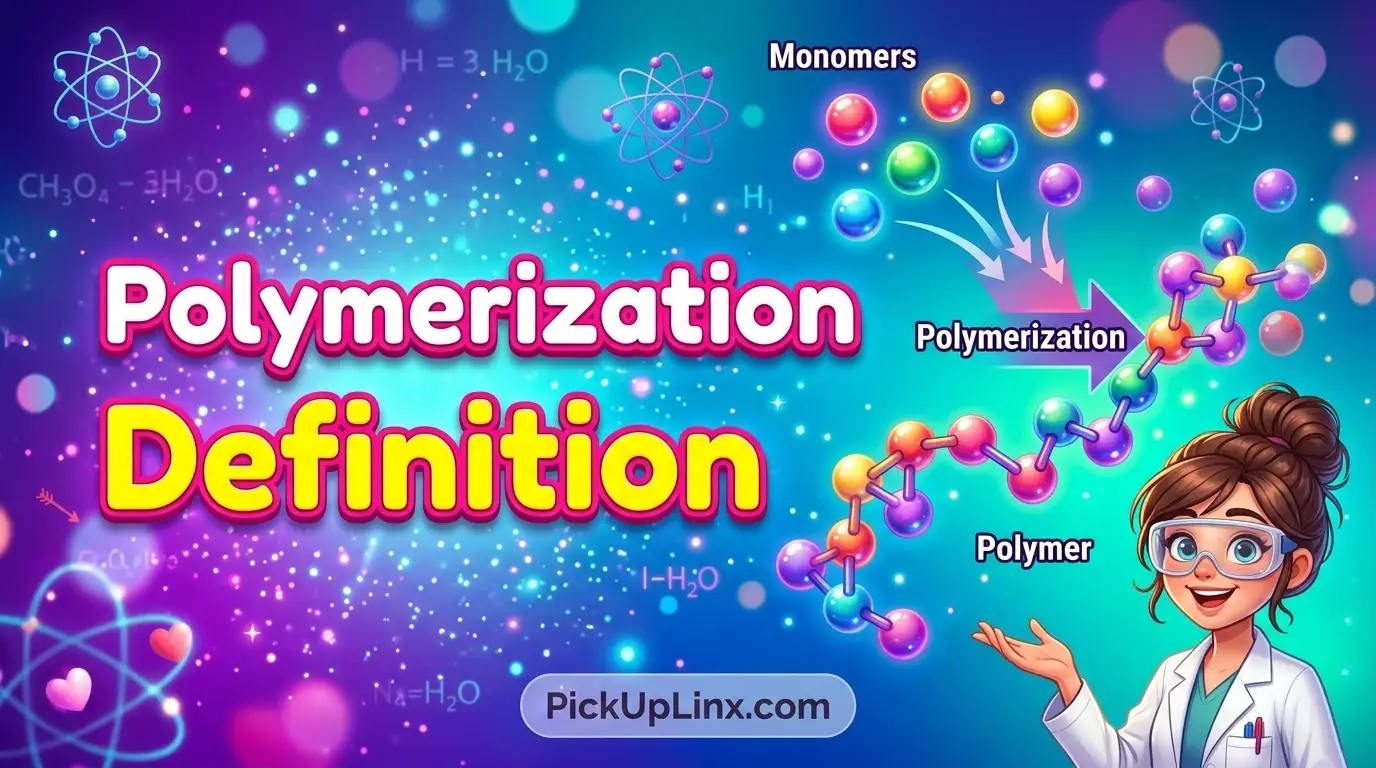
Polymerization Definition is a chemical process in which small molecules join together to form large molecules called polymers. These small molecules are known as monomers. The process creates materials with many uses, from plastic bottles and rubber tires to clothing fibers and medical products.
Polymerization can happen through different chemical reactions, depending on the monomers and the final material needed. Some polymers occur in nature, while others are made in factories. Understanding the polymerization definition helps explain how common materials are formed, why they have different properties, and how chemistry shapes many products used in daily life.
1. What Is the Definition of Polymerization?
Polymerization is a chemical reaction in which many small molecules join to form a larger molecule called a polymer. The small molecules that take part in this process are called monomers.
The word polymer comes from Greek roots that mean “many parts.” This name fits because a polymer contains many repeating units linked together.
Think of monomers as small building blocks. When they connect in the right way, they form a long chain or a larger network. This new structure may have properties that differ from those of the starting molecules.
For example, ethylene is a small molecule used to make polyethylene, a common plastic. During polymerization, many ethylene molecules link together to form long chains. These chains can be used to make bags, containers, pipes, and other products.
Polymerization can occur in nature or under controlled conditions in a laboratory or factory. Natural examples include the formation of proteins from amino acids and DNA from nucleotides.
The exact process depends on the chemicals involved. Some reactions join monomers directly, while others release small molecules as part of the reaction.
2. What Are Monomers and Polymers?
To understand polymerization, it helps to know the difference between a monomer and a polymer.
A monomer is a small molecule that can join with other molecules to form a larger structure. A polymer is the large molecule made from many linked units.
Monomers act as the starting materials. Polymerization changes how these units connect and creates a new molecular structure.
For example, many ethylene molecules can join to form polyethylene. Each ethylene molecule contributes a repeating unit to the growing chain.
Natural materials also contain polymers. Proteins, starch, cellulose, and DNA are important examples. Their building blocks differ, and their structures allow them to perform different jobs in living things.
Here is a simple comparison:
| Feature | Monomer | Polymer |
|---|---|---|
| Size | Usually a small molecule | Usually a large molecule |
| Structure | One building unit | Many linked units |
| Role | Starting material | Product or large molecular structure |
| Example | Ethylene | Polyethylene |
| Common use or role | Used to make polymers | Forms plastics, fibers, and biological materials |
Not every polymer has a simple straight chain. Some have branches, while others form connected networks. These differences affect strength, flexibility, heat resistance, and other properties.
A polymer’s features also depend on the type of monomer used and how the reaction is carried out.
3. How Does the Polymerization Process Work?
Polymerization follows a chemical pathway that allows monomers to connect. The exact steps depend on the reaction type, but the main idea is the same: small units form a larger molecular structure.
In a factory, scientists and engineers select suitable starting materials and control the reaction conditions. These may include temperature, pressure, catalysts, and the amount of each chemical.
A simple polymerization process often involves these steps:
- Choose the monomers. The starting molecules must be able to react and form the desired polymer.
- Prepare the reaction. The materials are placed under suitable conditions.
- Start the reaction. Heat, light, an initiator, or a catalyst may help the reaction begin.
- Join the units. Monomers react and become part of growing polymer chains or networks.
- Control the product. Conditions are managed to achieve the required molecular size and properties.
- Finish and process the polymer. The material may be separated, cleaned, shaped, or prepared for use.
For example, polyethylene production uses ethylene as the monomer. Under suitable conditions, the molecules react to form long chains.
Not all polymerization reactions follow these exact steps. Some happen through a chain reaction, while others involve repeated reactions between molecules with suitable functional groups.
The reaction conditions matter because they can affect the polymer’s molecular weight, structure, and final performance.
4. What Are the Main Types of Polymerization?
There are two major types often taught in basic chemistry: addition polymerization and condensation polymerization. More detailed classifications also include chain-growth and step-growth polymerization.
Addition Polymerization
In addition polymerization, monomers join without releasing a small molecule as a by-product in the basic reaction. Many common monomers contain carbon-carbon double bonds that open and form new bonds.
For example, ethylene molecules join to make polyethylene. The double bond in each ethylene molecule is converted into bonds that connect the repeating units.
Other examples include the formation of polypropylene and polyvinyl chloride (PVC).
Condensation Polymerization
In condensation polymerization, monomers with suitable reactive groups join, often releasing a small molecule such as water or methanol.
Nylon and some types of polyester can be made through reactions of this kind. The exact by-product depends on the chemicals and reaction route.
Chain-Growth and Step-Growth Polymerization
These terms describe how polymer chains grow.
In chain-growth polymerization, monomers add to an active site on a growing chain. In step-growth polymerization, molecules with reactive groups join in stages, and larger molecules can form as the reaction continues.
The terms addition and condensation are often used in introductory lessons, but they are not perfect substitutes for chain-growth and step-growth. Modern polymer chemistry includes reactions that do not fit every simple textbook rule.
5. Examples of Polymerization in Everyday Life
Polymerization helps make many materials used in homes, schools, hospitals, and industries. Some polymers are made from fossil-based raw materials, while others come from renewable sources or living organisms.
Here are some common examples.
Polyethylene: Made from ethylene, this polymer is used in packaging, bottles, containers, and pipes.
Polypropylene: Produced from propylene, it is found in food containers, household items, fibers, and some medical products.
Polyvinyl chloride (PVC): Made from vinyl chloride, PVC is used in pipes, cable insulation, flooring, and other building products.
Polystyrene: This polymer is used in some packaging materials, disposable products, and insulation.
Nylon: Certain nylon types are made through polymerization reactions involving specific monomers. They are used in textiles, ropes, and engineering parts.
Polyester: Some polyesters are used in clothing, bottles, and industrial materials.
Natural rubber: Rubber contains long polymer chains, mainly made from repeating units derived from isoprene.
The table below shows how polymerization connects chemistry with familiar products.
| Polymer | Starting Material or Building Blocks | Common Uses |
|---|---|---|
| Polyethylene | Ethylene | Bags, containers, pipes |
| Polypropylene | Propylene | Packaging, fibers, household goods |
| PVC | Vinyl chloride | Pipes, cables, flooring |
| Polystyrene | Styrene | Packaging, insulation |
| Nylon | Suitable reactive monomers | Clothing, ropes, machine parts |
| Polyester | Suitable reactive monomers | Fabrics, bottles |
| Natural rubber | Isoprene-based units | Tires and elastic products |
These materials do not all behave in the same way. Their properties depend on their molecular structure, additives, processing, and intended use.
6. What Factors Affect Polymerization?
Several factors influence how polymerization takes place and what kind of material forms. Manufacturers must control these conditions to make products with consistent properties.
Temperature: Heat can increase reaction speed, but too much heat may cause unwanted reactions or damage the material.
Pressure: Some processes use pressure to control how monomers react and how quickly the polymer forms.
Catalysts: A catalyst can help a reaction proceed by providing a more suitable pathway. Different catalysts can also affect the structure of the polymer.
Initiators: Some chain-growth reactions use an initiator to create reactive species that start the chain reaction.
Monomer type: The chemical structure of a monomer affects which reactions it can undergo and what properties the polymer may have.
Concentration: The amount of monomer and other ingredients can influence reaction speed and the final product.
Reaction time: The length of time a reaction continues can affect conversion and, in some systems, the size of the polymer molecules.
Purity: Unwanted substances may interfere with some reactions or affect the quality of the final material.
For example, polyethylene made under different conditions can have different chain structures and properties. These differences help determine whether a grade is suitable for flexible film, containers, or stronger molded products.
There is no single set of conditions for every polymer. Each reaction needs a process suited to its chemistry and intended use.
7. Why Is Polymerization Important?
Polymerization is important because it allows scientists to create materials with properties suited to many tasks. By choosing monomers and controlling the reaction, manufacturers can produce polymers that are flexible, rigid, light, strong, or resistant to certain chemicals.
In healthcare, polymers are used in items such as medical tubing, syringes, selected implants, and drug-delivery systems. Each medical use requires careful testing and suitable material standards.
In construction, polymer materials appear in pipes, insulation, sealants, flooring, and coatings.
In transport, polymers help make tires, interior parts, protective coatings, and lightweight components.
In textiles, synthetic fibers such as polyester and nylon are used to make clothing, ropes, and fabrics.
In electronics, polymers may serve as insulation, protective coatings, or parts of specialized devices.
In food packaging, selected polymers help protect products from moisture, dirt, and physical damage.
Polymerization also matters in biology. Living organisms build proteins, DNA, and complex carbohydrates through processes that form large molecules from smaller building blocks.
The ability to create and study polymers has changed modern manufacturing. However, their usefulness also brings responsibility. The production, use, and disposal of some polymers can create environmental problems, especially when waste is not managed well.
8. What Is the Difference Between Polymerization and Polymers?
The terms polymerization and polymer are closely related, but they refer to different things.
Polymerization is the process. A polymer is the product or resulting large molecule.
For example, when ethylene molecules react to form polyethylene, the chemical reaction is polymerization. The polyethylene produced is the polymer.
This difference is similar to baking bread. Baking is the process, while bread is the product. The comparison is not a chemical explanation, but it helps make the terms easier to remember.
A polymer does not always have to be made in a factory. Natural polymers form in living systems, and some occur as part of plants, animals, and microorganisms.
Polymerization is also not the same as melting or shaping plastic. Those steps may happen after a polymer has formed. Heating a finished plastic and molding it into a bottle, for example, changes its shape rather than necessarily building its molecular chains from monomers.
| Term | Meaning | Example |
|---|---|---|
| Monomer | Small molecule that can join with others | Ethylene |
| Polymerization | Chemical process that links units | Ethylene reacting to form polyethylene |
| Polymer | Large molecule made of linked units | Polyethylene |
| Plastic processing | Method used to shape a material | Molding polyethylene into a container |
Understanding these terms helps explain how raw chemicals become useful materials.
9. What Are the Environmental Effects of Polymerization?
Polymerization can support useful products, but the full life cycle of a polymer matters. Environmental effects may come from raw material extraction, energy use, manufacturing, transportation, and disposal.
Many common plastics are durable. This can make them useful for long-lasting products, but discarded plastic can remain in the environment for a long time. Larger pieces may break into smaller fragments, including microplastics.
Plastic waste can harm wildlife, block drains, and pollute land and water. Some products are hard to recycle because they contain mixed materials, additives, or several types of plastic.
However, not all polymers have the same environmental impact. Their effects depend on how they are made, how long they are used, whether they can be reused or recycled, and how they are handled at the end of their life.
Ways to reduce waste include:
- Reusing products when it is safe and practical.
- Choosing durable items instead of short-lived alternatives.
- Sorting recyclable materials according to local rules.
- Reducing unnecessary packaging.
- Supporting better collection and waste-management systems.
Biobased polymers may use renewable raw materials, but biobased does not always mean biodegradable. Likewise, biodegradable materials need the right conditions to break down, and some require industrial composting facilities.
The goal is to assess the complete life cycle rather than assume that every plastic is harmful or that every alternative is automatically better.
10. How Is Polymerization Used in Science and Industry?
Scientists use polymerization to develop materials for specific needs. Industrial teams study the starting chemicals, reaction conditions, and final properties before choosing a process.
For example, a company making packaging film may need a polymer that bends without breaking. A manufacturer producing pipes may need a material with suitable strength, chemical resistance, and long-term performance.
Researchers can adjust the choice of monomer, catalyst, and reaction method to change the structure of a polymer. They can then test properties such as strength, flexibility, heat resistance, and durability.
Polymerization is also used to create specialized materials. These include coatings, adhesives, hydrogels, synthetic fibers, and polymers used in selected medical applications.
In research laboratories, scientists may study how fast a reaction occurs, how long the chains become, and how repeating units are arranged. These details can help explain why one polymer performs differently from another.
Safety is important in polymer production. Some monomers, initiators, solvents, and catalysts can be hazardous. Industrial processes must follow suitable controls for handling chemicals, managing heat, preventing leaks, and treating waste.
Polymerization is therefore more than a basic chemistry reaction. It is a key tool for designing materials that meet specific needs in science, medicine, manufacturing, and daily life.
People Also Ask About Polymerization Definition
1. What is polymerization in simple words?
Polymerization is a chemical process in which many small molecules, called monomers, join to form larger molecules known as polymers.
2. What is an example of polymerization?
One example is the reaction of ethylene molecules to form polyethylene. This polymer is used in products such as plastic bags, containers, and pipes.
3. What are the two main types of polymerization?
Two types often taught in basic chemistry are addition polymerization and condensation polymerization. They differ in how monomers join and whether small molecules are released during the reaction.
4. What is the difference between a monomer and a polymer?
A monomer is a small molecule that can join with others. A polymer is a larger molecule made from many linked units.
5. Is polymerization a chemical reaction?
Yes. Polymerization is a chemical reaction or group of reactions in which monomers connect to form polymer chains or networks.
6. Where is polymerization used?
Polymerization is used to make plastics, synthetic fibers, rubber materials, coatings, adhesives, and selected medical products. Natural polymer formation also occurs in living organisms.
7. Is polymerization harmful to the environment?
Polymerization itself is a chemical process, but producing and disposing of some polymers can affect the environment. The impact depends on the materials, energy used, product life, and waste-management methods.
Conclusion
The polymerization definition describes the chemical process that joins small molecules called monomers to form larger molecules known as polymers. This process creates materials used in packaging, construction, healthcare, clothing, and many other fields. Addition and condensation polymerization are two common types, while reaction conditions help determine the final material’s structure and properties.
Understanding polymerization explains how many everyday products are made and why their features differ. It also highlights the need to produce, use, and dispose of polymer materials responsibly.

Julian Lovett – A passionate writer who shares charming pickup lines, romantic ideas, and fun love content to help people spark connections and smiles. ❤️