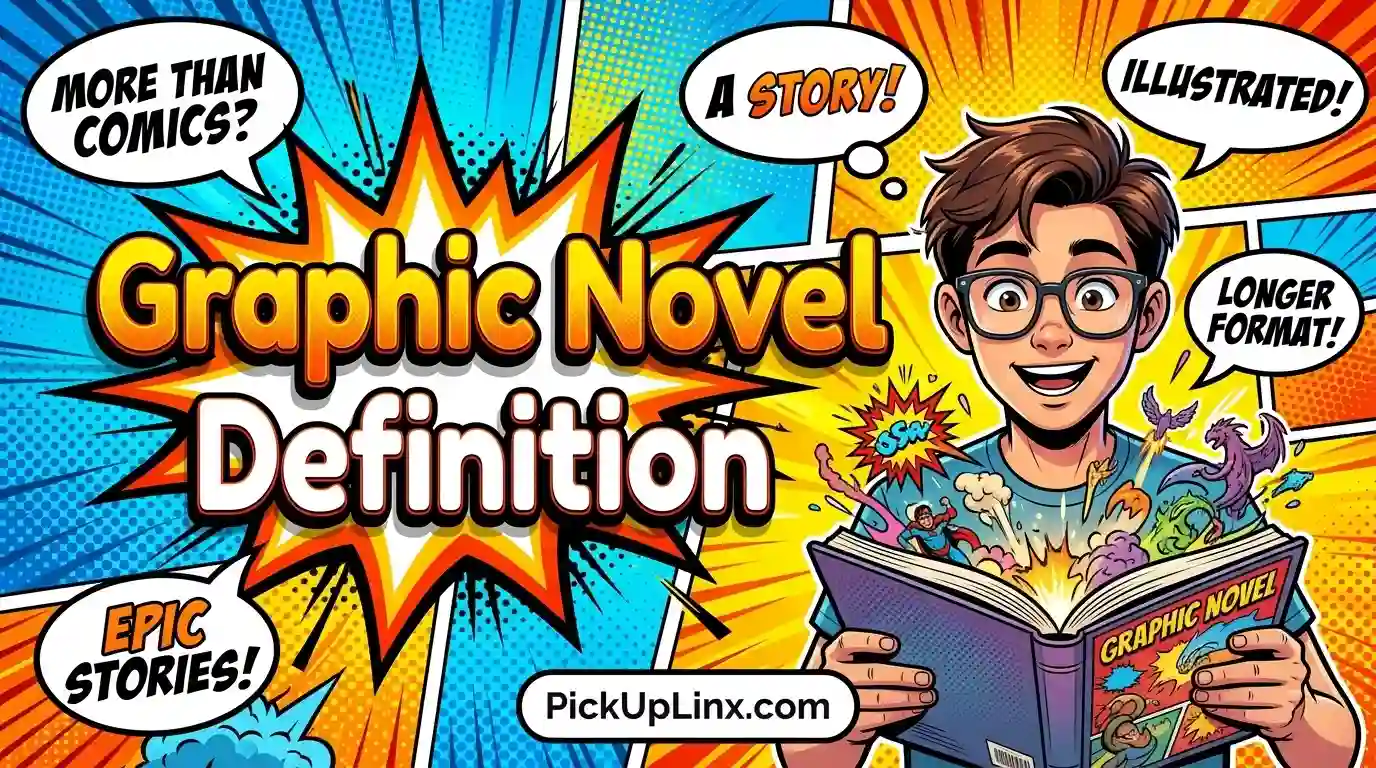
A Graphic Novel Definition is a book that tells a story through pictures and written words. It uses artwork, speech bubbles, captions, and panels to show what happens. Unlike a single comic issue, a graphic novel often presents a longer, complete story in book form. It can include many genres, such as fantasy, mystery, romance, history, and adventure.
Graphic novels are written for children, teens, and adults. They may tell fictional stories or share real events and personal experiences. Understanding the graphic novel definition helps readers see how words and images work together to create a meaningful reading experience.
1. What Is the Definition of a Graphic Novel?
A graphic novel is a book-length work that tells a story mainly through a combination of illustrations and text. The story moves through a series of panels, which are small sections of artwork arranged on a page.
Each panel shows a moment, action, or part of a scene. Speech bubbles show what characters say, while captions may explain events, thoughts, or changes in time.
For example, a graphic novel about a young detective may show the character finding a clue, questioning a witness, and solving a mystery. The artwork helps readers understand the action, while the words add dialogue and detail.
Graphic novels can be fictional or based on real life. Some tell made-up stories about heroes and magical worlds. Others explore history, family life, social issues, or personal memories.
The term describes a format of storytelling, not one specific subject or art style. A graphic novel may be funny, serious, educational, or dramatic. What makes it a graphic novel is the way it uses sequential images and words to tell a longer story.
2. What Are the Main Features of a Graphic Novel?
Graphic novels use several visual and written elements to help readers follow a story. Each element has a purpose.
Panels: These are individual frames that show moments in the story. A page may contain a few large panels or many small ones.
Speech bubbles: These show what characters say. Their shape and placement can help readers identify the speaker.
Captions: These provide extra information, such as a character’s thoughts, a change in time, or details about a place.
Illustrations: Drawings show characters, settings, actions, and emotions. They may use simple lines or detailed artwork.
Sequential storytelling: The panels appear in an order that helps readers understand what happens first, next, and last.
Visual effects: Lines, colors, symbols, and changes in panel size can show movement, sound, tension, or mood.
For example, an artist may draw a character with wide eyes to show surprise. A large panel of a storm may create a feeling of danger. Short speech bubbles can make a conversation feel quick and lively.
These features work together to tell the story. Readers do not need long blocks of text to understand every event because the pictures also carry important meaning.
3. How Is a Graphic Novel Different From a Comic Book?
Graphic novels and comic books both use images and words to tell stories. The main difference often lies in their length, format, and how the story is published.
A comic book is commonly released as a shorter issue. It may be one part of a larger story that continues in later issues.
A graphic novel is usually published as a longer book. It may tell a complete story in one volume or collect several connected chapters or comic issues.
However, these categories can overlap. Some graphic novels are short, and some comic books contain complete stories. The labels do not always follow strict rules.
| Feature | Graphic Novel | Comic Book |
|---|---|---|
| Length | Often book-length | Often shorter |
| Story format | May contain a complete story | May be one part of a series |
| Publication | Commonly sold as a book | Often released in individual issues |
| Reading experience | May cover a longer story arc | May focus on one episode or chapter |
| Genres | Many genres and subjects | Many genres and subjects |
| Artwork | Uses sequential images | Uses sequential images |
For example, a 200-page story about a family moving to a new country may be published as a graphic novel. A 25-page superhero adventure that continues next month may be published as a comic book.
Neither format is automatically better. Both can tell complex, creative, and meaningful stories.
4. What Are the Different Types of Graphic Novels?
Graphic novels cover a wide range of subjects. Readers can choose a type that matches their interests, age, or reading goals.
Fiction graphic novels tell invented stories. They may include imaginary characters, places, and events.
Fantasy graphic novels feature magic, mythical creatures, unusual worlds, or supernatural powers.
Science fiction graphic novels explore ideas such as space travel, robots, future societies, and advanced technology.
Mystery graphic novels follow characters as they investigate clues and solve problems.
Historical graphic novels use visual storytelling to explore past events, people, or time periods. Some are fictional, while others are based closely on real history.
Memoir graphic novels share personal experiences from the author’s life. They may explore family, identity, travel, or major life changes.
Educational graphic novels explain subjects such as science, health, or history through pictures and text.
Romance and drama graphic novels focus on relationships, emotions, and personal choices.
Horror graphic novels use dark settings, suspense, and frightening events to create tension.
These types can overlap. A story may combine fantasy and mystery, or history and personal memoir.
For example, a book about a young scientist who travels through time might be both science fiction and adventure. The genre depends on the main themes and events in the story.
5. How Do Pictures and Words Work Together?
The most important feature of a graphic novel is the way its images and words support each other. The pictures do more than decorate the page. They help tell the story.
Words can explain a character’s thoughts, give background information, or show dialogue. Images can reveal feelings, actions, and details that are hard to describe in a few sentences.
Consider this example.
A character enters a dark room. The caption says, “I knew something was wrong.” The picture shows a broken window, a fallen chair, and a shadow near the door.
The words create a sense of worry, while the artwork gives readers clues about what may have happened.
Graphic novels also use visual storytelling to control the pace of a scene. Several small panels may show quick actions, such as a character running down a hallway. One large panel may slow the moment and draw attention to a major event.
The space between panels is important, too. Readers often use their imagination to connect one image to the next. If one panel shows a character reaching for a door and the next shows the door open, readers understand the action that took place between them.
This combination allows graphic novels to tell stories in a way that is different from text-only books.
6. What Is the Structure of a Graphic Novel?
Most graphic novels have a clear story structure, even when they use unusual artwork or non-linear events.
A common structure includes the beginning, middle, and end.
Beginning: Readers meet the main characters and learn about the setting. The story introduces a problem, goal, or important event.
Middle: The characters face challenges and make choices. New details may change how readers understand the story.
Ending: The main conflict reaches a result. Some stories solve the central problem, while others leave room for thought or a future book.
The visual layout also shapes the reading experience.
A panel shows one part of the story. A gutter is the space between panels. A page layout is the way panels are arranged on a page. These elements guide the reader’s eyes and help control the pace.
For example, a mystery graphic novel may begin with a missing necklace. The middle shows the detective finding clues and questioning suspects. The ending reveals who took the necklace and why.
Not every graphic novel follows a simple timeline. Some move between past and present. Others use memories, dreams, or different points of view.
Even when the structure is complex, the artwork and text help readers follow the main ideas.
7. What Are Some Famous Graphic Novel Examples?
Many well-known books show how flexible the graphic novel format can be. Some focus on fantasy and adventure, while others explore real events or personal experiences.
Here are a few examples:
- Maus by Art Spiegelman: A graphic memoir about the Holocaust and the experiences of the author’s father. It uses animal characters to represent different groups of people.
- Persepolis by Marjane Satrapi: A graphic memoir about growing up in Iran during and after the Islamic Revolution.
- Smile by Raina Telgemeier: A graphic memoir about the author’s childhood, dental treatment, friendships, and growing up.
- American Born Chinese by Gene Luen Yang: A story that explores identity, belonging, and cultural expectations through connected storylines.
- Nimona by ND Stevenson: A fantasy story about a shape-shifting character and a knight in a world that mixes magic and technology.
- The Arrival by Shaun Tan: A wordless graphic novel about a person who moves to an unfamiliar land and faces the challenges of starting over.
These books show that graphic novels are not limited to superheroes or light entertainment. They can explore serious subjects, personal struggles, history, and social questions.
They also show how different artists use panels, color, character design, and visual symbols to create unique reading experiences.
When choosing a graphic novel, consider its subject, age rating, themes, and reading level. A book that works well for one reader may not suit another.
8. What Is the Difference Between a Graphic Novel and a Picture Book?
Graphic novels and picture books both use artwork to tell stories. However, they often differ in length, layout, and how the story develops.
A picture book usually tells a shorter story. It often uses one large illustration per page or spread, with text placed beside or over the artwork.
A graphic novel commonly uses a sequence of panels. These panels show several moments within a scene and allow the story to unfold step by step.
| Feature | Graphic Novel | Picture Book |
|---|---|---|
| Typical length | Often longer | Often shorter |
| Page layout | Usually uses multiple panels | Often uses full-page or large illustrations |
| Story detail | May develop several characters and conflicts | Usually focuses on a simpler story |
| Dialogue | Often shown in speech bubbles | Often appears as regular text |
| Intended readers | Children, teens, and adults | Often young children, though not always |
| Visual flow | Readers follow sequences of panels | Readers follow illustrations and text across pages |
These are general patterns, not strict rules. Some picture books have complex themes, and some graphic novels are short and simple.
For example, a picture book may tell a brief story about a child learning to share. A graphic novel may follow the same child through many events, friendships, and challenges over several chapters.
Both formats can support reading and learning. The best choice depends on the story and the reader’s needs.
9. Why Are Graphic Novels Important for Readers?
Graphic novels can offer several benefits. They combine visual details with written language, giving readers more than one way to understand a story.
They support reading interest. Pictures, dialogue, and action can make stories inviting for readers who find long blocks of text difficult.
They build visual literacy. Readers learn to understand facial expressions, symbols, panel order, and visual clues.
They support vocabulary. Dialogue and captions introduce new words in a clear story context.
They encourage imagination. Readers use both written details and artwork to picture events and connect ideas.
They explore complex themes. Graphic novels can discuss history, identity, family, conflict, and other serious topics in an accessible format.
They help readers study storytelling. The use of panel size, color, timing, and dialogue shows how authors and artists shape a reader’s experience.
For example, a graphic novel about a historical event may help students see clothing, buildings, and daily life in a particular period. The written text can explain facts that the pictures alone cannot provide.
Still, graphic novels vary in difficulty. Some use simple words and short sentences, while others contain mature themes, advanced vocabulary, or complex ideas.
They should not be treated as less valuable than traditional novels. Both formats can offer strong writing, meaningful themes, and thoughtful stories.
10. How to Choose and Read a Graphic Novel
Choosing a graphic novel becomes easier when you know what you enjoy and what kind of reading experience you want.
Start by choosing a genre. If you enjoy solving puzzles, try a mystery. You like imaginary worlds, look for fantasy or science fiction. If you want to learn about real events, consider a historical graphic novel or memoir.
Next, check the age guidance and themes. Some books are written for young readers, while others include violence, difficult topics, or mature content.
You can also read a short preview. Look at the artwork, speech bubbles, panel layout, and writing style. These features can help you decide whether the book suits your interests.
Use these tips when reading:
- Follow the panels in the intended order, usually from left to right and top to bottom in English-language books.
- Read speech bubbles and captions carefully.
- Notice facial expressions, colors, and background details.
- Think about what happens between panels.
- Ask how the pictures add meaning to the words.
- Pause after a page or chapter to reflect on the main event.
For example, if a character looks calm in the dialogue but has clenched fists in the artwork, the images may suggest hidden anger or fear.
You can also compare a graphic novel with a prose novel about a similar topic. Notice how each format handles description, dialogue, and pacing.
Reading with attention to both words and images can help you enjoy the story and understand how visual storytelling works.
People Also Ask About Graphic Novel Definition
1. What is a graphic novel in simple words?
A graphic novel is a book that tells a story through pictures and words. It often uses panels, speech bubbles, captions, and illustrations to show events and conversations.
2. What is the main purpose of a graphic novel?
Its purpose is to tell a story or share information through visual and written elements. Graphic novels can entertain readers, explain real events, or explore complex themes.
3. What is the difference between a graphic novel and a comic?
A graphic novel is usually published as a book-length story, while a comic book is often shorter and may be part of a series. However, the two formats can overlap.
4. Are graphic novels real books?
Yes. Graphic novels are books that use sequential art and text to tell stories. They can contain fiction, memoir, history, or educational content.
5. What are the main elements of a graphic novel?
Common elements include panels, gutters, speech bubbles, captions, illustrations, characters, and a clear story sequence. These features help readers understand the events.
6. Are graphic novels suitable for children?
Many graphic novels are made for children, but others are intended for teens or adults. Check the book’s age guidance, themes, and content before choosing one.
7. Can a graphic novel be based on a true story?
Yes. Graphic memoirs, biographies, and historical graphic novels may describe real people and events. Some combine documented facts with creative storytelling, so readers should check the author’s notes when accuracy matters.
Conclusion
The graphic novel definition describes a book that uses pictures and words together to tell a story. Its panels, captions, speech bubbles, and illustrations help readers follow events and understand characters. Graphic novels cover many genres, from fantasy and mystery to memoir and history.
They can entertain, teach, and encourage readers to think about important topics. Whether you are a student, a new reader, or a lifelong book lover, exploring graphic novels can introduce you to a rich form of storytelling that brings language and art together.

Julian Lovett – A passionate writer who shares charming pickup lines, romantic ideas, and fun love content to help people spark connections and smiles. ❤️