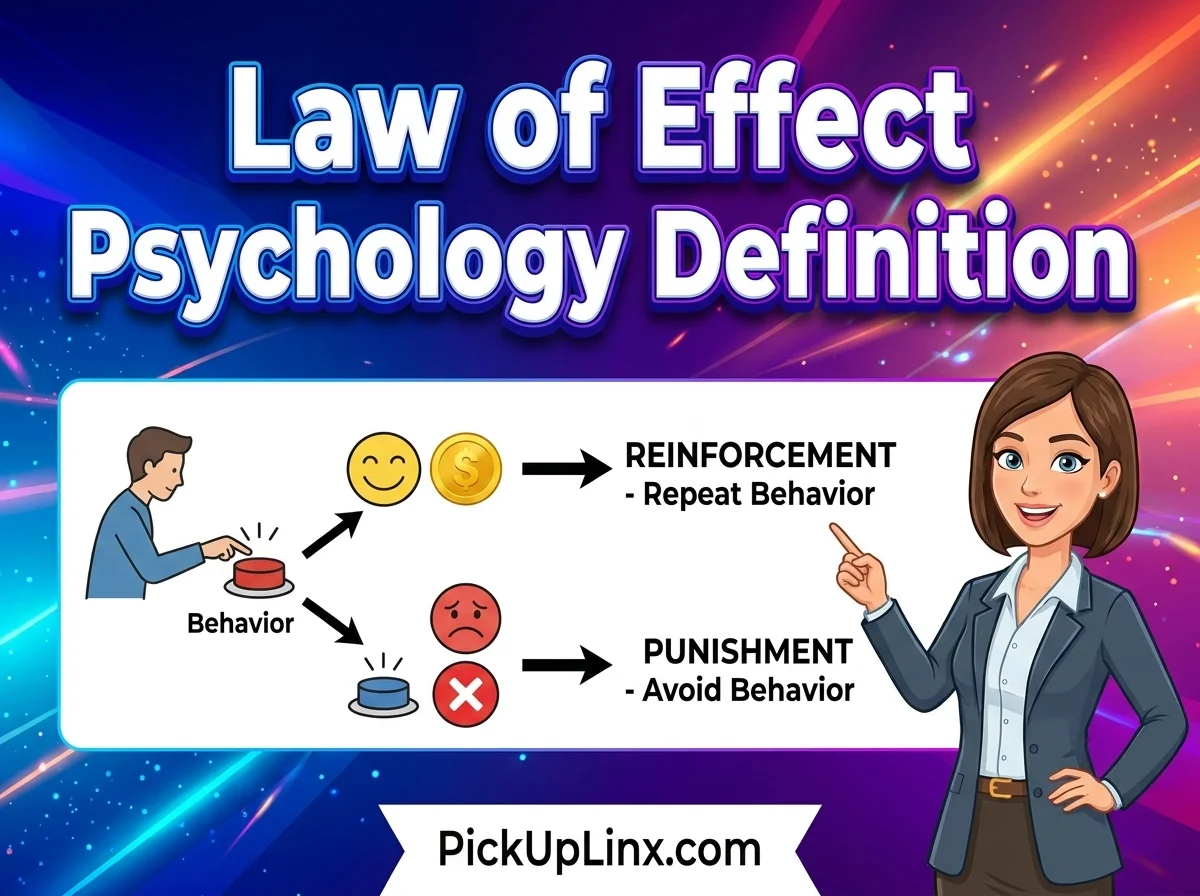
The law of effect psychology definition explains how the results of an action can change the chance of that action happening again. Psychologist Edward Thorndike introduced this idea in the early 1900s while studying how animals learned through trial and error.
The basic idea is simple behaviors followed by satisfying results become more likely, while behaviors followed by unpleasant results become less likely. This principle helped shape the study of learning, behavior, and conditioning.
Today, the law of effect remains an important concept in psychology because it shows how consequences can guide future behavior in people and animals.
1. What Is the Law of Effect?
The law of effect is a psychological principle about learning. It states that the results of a behavior affect how likely that behavior is to occur again.
When an action leads to a satisfying outcome, the person or animal is more likely to repeat it. When an action leads to an unpleasant outcome, repeating it becomes less likely.
For example, imagine a student studies hard for a test and receives a high grade. The good result may make the student more willing to study in the same way before the next test.
The law does not mean that every pleasant result creates a lasting habit. Many factors affect behavior. Still, the idea gives us a simple way to understand how consequences influence learning.
2. Who Developed the Law of Effect?
The law of effect was developed by Edward L. Thorndike, an American psychologist known for his work on learning and animal behavior.
Thorndike studied how animals learned to solve simple problems. His famous experiments involved cats placed inside puzzle boxes. The animals had to perform an action, such as pulling a loop or pressing a mechanism, to escape and reach food.
At first, the cats tried many different movements. Some actions worked by chance. After repeated trials, the cats became faster at using the action that helped them escape.
Thorndike used these observations to explain how learning can develop through trial and error.
His work became an important part of early behaviorist psychology.
3. Thorndike’s Puzzle Box Experiment
Thorndike’s puzzle box experiment is closely connected to the law of effect.
A hungry cat was placed inside a box. Food was placed outside where the cat could see it. The cat had to discover how to open the box.
During the first attempt, the cat made many movements. It scratched, pushed, pulled, and moved around the box. Eventually, it accidentally performed the action that opened the door.
After several attempts, the cat began escaping more quickly.
Thorndike believed that the successful action became stronger because it was followed by a satisfying result: freedom and access to food.
The important point was not that the cat suddenly understood the puzzle. Instead, learning appeared to happen gradually through trial and error.
This observation supported Thorndike’s idea that consequences can strengthen or weaken behavior.
4. How Does the Law of Effect Work?
The law of effect can be understood through a simple sequence:
Behavior → Consequence → Future behavior
Suppose someone asks a question in class. The teacher gives a helpful answer and praises the student for asking. The positive experience may increase the chance that the student will ask questions again.
Now imagine the student asks a question and receives an unpleasant response. The student may become less willing to speak up in the future.
The process can be summarized like this:
| Behavior | Result | Possible Future Effect |
|---|---|---|
| Studying | Good grade | More studying |
| Asking for help | Useful support | More help-seeking |
| Practicing a skill | Improvement | More practice |
| Touching a hot object | Pain | Less likely to touch it again |
| Interrupting | Negative response | Less interruption |
These examples show the basic relationship between actions and consequences.
5. Positive and Negative Outcomes
The law of effect focuses on whether an outcome is satisfying or unpleasant for the learner.
A satisfying outcome can strengthen a behavior. An unpleasant outcome can weaken it.
For example, a child cleans their room and receives praise from a parent. The praise may encourage the child to clean again.
Another child touches a hot pan and feels pain. That experience may make the child avoid touching hot objects later.
It is important to understand that the law of effect is about the effect of consequences on future behavior. It is not simply a rule saying that good things always produce good behavior.
People respond differently to the same outcome. What feels rewarding to one person may not matter much to another.
6. Law of Effect Examples in Daily Life
The law of effect can be seen in many ordinary situations.
Studying
A student studies regularly and earns better grades. The improvement may encourage the student to continue studying.
Exercise
Someone starts exercising and notices better energy and fitness. These satisfying results can make regular exercise easier to maintain.
Work
An employee completes a task and receives praise from a manager. The positive response may encourage similar effort in the future.
Social Behavior
A person tells a funny joke and friends laugh. The enjoyable reaction may encourage the person to tell more jokes.
Learning a Skill
A beginner practices playing an instrument. As the person improves, the progress itself can encourage more practice.
In each case, a result follows an action, and that result can affect what happens next.
7. Law of Effect and Trial-and-Error Learning
The law of effect is strongly linked to trial-and-error learning.
Trial and error happens when someone tries different actions until one produces a useful result. Successful actions become more likely to be repeated.
Imagine a person learning how to use unfamiliar software. They click different buttons and explore different menus. Eventually, they find the correct setting.
The next time they need the same feature, they are more likely to use the successful method.
This process may happen without a person clearly explaining every step to themselves. Experience helps shape future responses.
Thorndike’s research suggested that learning can develop through repeated experiences rather than through sudden insight alone.
8. Law of Effect vs. Operant Conditioning
The law of effect helped influence later ideas about learning, especially operant conditioning.
Psychologist B. F. Skinner later developed operant conditioning, which examined how consequences affect behavior in a more detailed way.
The two ideas are related, but they are not identical.
| Law of Effect | Operant Conditioning |
|---|---|
| Developed by Edward Thorndike | Developed mainly by B. F. Skinner |
| Focuses on satisfying or unpleasant results | Examines how consequences change behavior |
| Based on early trial-and-error research | Uses a broader experimental framework |
| Helped shape later learning theories | Includes concepts such as reinforcement and punishment |
Thorndike’s work came earlier and helped create a foundation for later research into behavior and learning.
9. Why Is the Law of Effect Important?
The law of effect is important because it helped psychologists understand that behavior is influenced by its consequences.
Before modern learning theories developed, explanations of behavior often focused heavily on instinct, reasoning, or other internal processes. Thorndike’s work placed greater attention on what happens after an action.
This shift had a major influence on psychology.
The principle also helped researchers study learning in observable ways. Instead of asking only what someone was thinking, psychologists could examine:
- What behavior occurred?
- What happened afterward?
- Did the behavior increase?
- Did it decrease?
- Did the result change future responses?
These questions remain useful when studying habits, learning, motivation, and behavior change.
10. Applications of the Law of Effect
The law of effect can help explain behavior in education, parenting, workplaces, training, and everyday life.
Education
Teachers can use helpful feedback to encourage students to keep practicing. When learners see progress, they may become more motivated to continue.
Parenting
Parents often encourage desired behavior through praise, attention, or other positive responses. These consequences can affect whether a child repeats the behavior.
Workplace Learning
Employees may repeat behaviors that lead to useful feedback, recognition, or successful results.
Animal Training
Animal training often relies on consequences. When an animal performs a desired action and receives a reward, the action may become more frequent.
Personal Habits
People also learn from their own experiences. If a behavior produces a useful result, it may become part of a routine.
However, the law of effect should not be treated as a complete explanation of every human action. Emotions, beliefs, memory, social factors, goals, and environment can also influence behavior.
People Also Ask About Law of Effect Psychology Definition
What is the law of effect in psychology?
The law of effect says that behaviors followed by satisfying consequences become more likely to occur again, while behaviors followed by unpleasant consequences become less likely.
Who created the law of effect?
Edward Thorndike developed the law of effect from his research on animal learning and trial-and-error behavior.
What is a simple example of the law of effect?
A student studies, receives a good grade, and feels satisfied. The positive result may make the student more likely to study again.
What was Thorndike’s puzzle box?
The puzzle box was an experimental setup used by Thorndike to study how cats learned to escape from an enclosed space and reach food.
Is the law of effect the same as reinforcement?
They are closely related, but they are not exactly the same. The law of effect is an early principle about how consequences influence future behavior. Reinforcement became a more developed concept in later learning theories.
How does the law of effect relate to behaviorism?
The law of effect helped support the behaviorist focus on observable behavior and environmental consequences. It became an important foundation for later research on learning.
Why is the law of effect important today?
The principle remains useful for understanding how feedback and consequences shape behavior. It also provides historical background for modern theories of learning and behavior.
Conclusion
The law of effect psychology definition is simple: the consequences of an action can influence whether that action happens again. Edward Thorndike developed the idea through his studies of animal learning and trial-and-error behavior. His puzzle box experiments showed how successful actions could become more common over repeated attempts.
The principle later influenced important ideas about reinforcement, conditioning, habits, and learning. While it does not explain every part of human behavior, the law of effect remains a useful foundation for understanding how experience can shape what we do next.

Julian Lovett – A passionate writer who shares charming pickup lines, romantic ideas, and fun love content to help people spark connections and smiles. ❤️



2 thoughts on “Law of Effect Psychology Definition Explained”