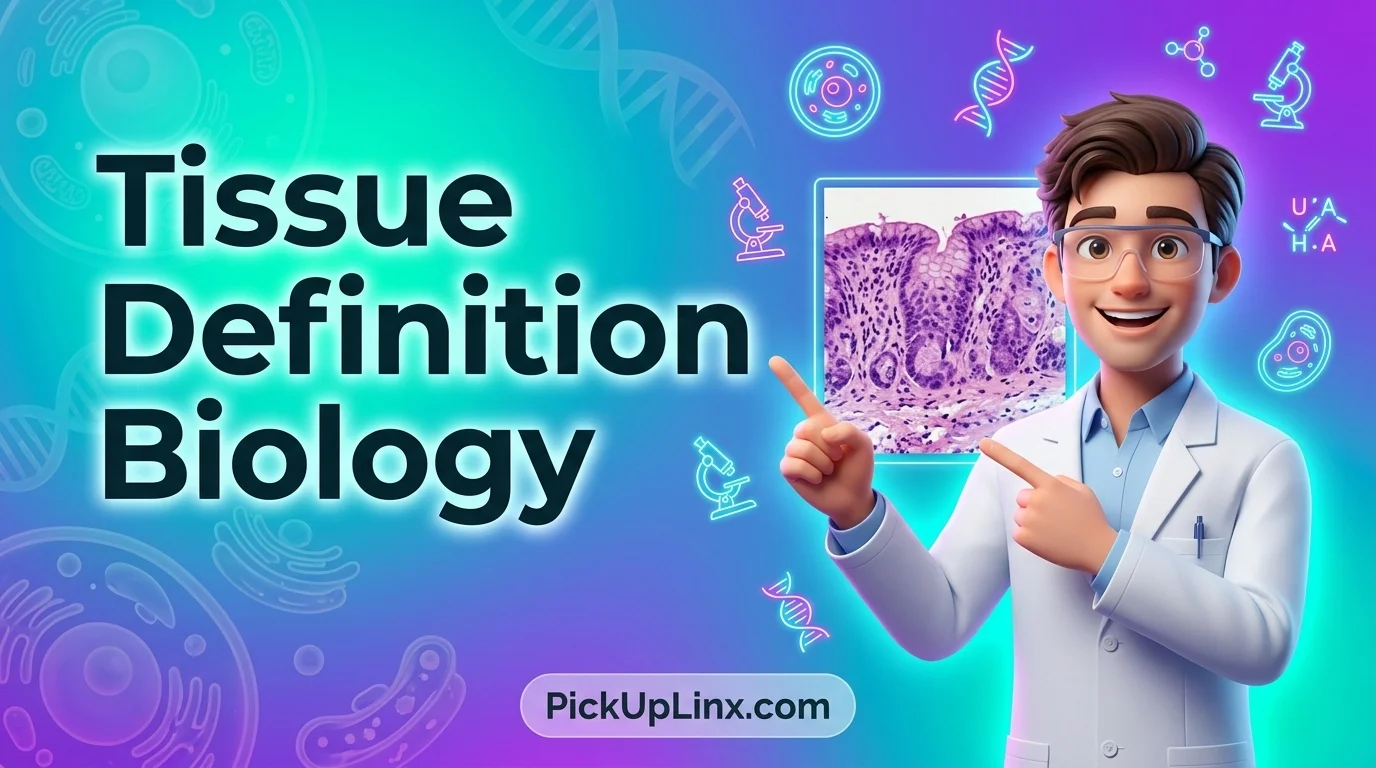
“In biology, a tissue definition refers to a group of similar cells that work together to perform a specific job. Tissues are a key level of organization in living things. In animals, cells join to form tissues, tissues build organs, and organs work together in organ systems. The main animal tissues are epithelial, connective, muscle, and nervous tissue.”
Each type has a different structure and role. For example, epithelial tissue covers the skin, muscle tissue helps the body move, and nervous tissue sends signals. Learning the tissue definition in biology helps explain how cells work together to keep an organism alive and functioning.
1. What Is a Tissue in Biology?
The basic tissue definition in biology is a group of similar cells that work together to carry out one or more specific functions.
Cells in a tissue may have similar shapes and structures because they are designed for related jobs. They do not work as separate units. Instead, they cooperate to perform a task that helps the body.
For example, muscle cells are built to contract. When many muscle cells work together, they form muscle tissue that can produce movement.
A tissue can contain more than just cells. Some tissues also have material between their cells called the extracellular matrix. This material can provide support, strength, or a place for cells to attach.
The idea is simple:
Cells → Tissues → Organs → Organ Systems → Organism
For example:
Muscle cells → Muscle tissue → Heart → Circulatory system → Human body
This organization allows complex organisms to perform many tasks at the same time.
2. How Do Cells Form Tissues?
Tissues form through a process called cell division and differentiation.
First, cells divide to produce more cells. As an organism grows, some cells become specialized. This means they develop features that help them perform a particular function.
For example, a developing human has cells that can later become muscle cells, nerve cells, or skin cells.
Cells with similar roles can then arrange themselves into groups. These groups form tissues.
Cell communication is also important. Cells send and receive signals that help control growth, repair, and normal activity.
A tissue therefore depends on cooperation. If the cells in a tissue cannot communicate or work properly, the tissue may not perform its normal function.
3. What Are the Four Main Animal Tissues?
Biologists usually divide animal tissues into four major types:
| Tissue Type | Main Function | Example |
|---|---|---|
| Epithelial | Covers and protects surfaces | Skin lining |
| Connective | Supports, joins, and protects | Bone and blood |
| Muscle | Produces movement | Heart muscle |
| Nervous | Sends and processes signals | Brain tissue |
Each group contains different subtypes.
Epithelial tissue forms coverings and linings.
Connective tissue provides support and connects body parts.
Muscle tissue contracts to create movement.
Nervous tissue carries electrical and chemical signals.
Although these tissues have different jobs, they work together to keep the body stable.
4. Epithelial Tissue
Epithelial tissue covers the outside of the body and lines many internal organs and spaces.
The skin is a familiar example. Epithelial tissue also lines parts of the digestive tract, blood vessels, and respiratory system.
Its cells are often packed closely together. This arrangement helps form a protective barrier.
Depending on its location, epithelial tissue may:
- Protect tissues underneath
- Absorb substances
- Release substances
- Help exchange gases
- Detect certain signals
For example, epithelial cells in the small intestine help absorb nutrients from digested food.
Some epithelial tissue also forms glands. Gland cells produce substances such as mucus, sweat, or digestive fluids.
The shape and arrangement of epithelial cells can vary. Some are flat, while others are cube-shaped or tall and column-like. Their structure matches their function.
5. Connective Tissue
Connective tissue supports, joins, protects, or separates different parts of the body.
Unlike epithelial tissue, connective tissue often has more material surrounding its cells. This material is called the extracellular matrix.
The matrix can be soft, firm, or hard.
Examples include:
- Bone – gives the body strength and support.
- Cartilage – provides flexible support and cushions joints.
- Fat tissue – stores energy and helps insulate the body.
- Blood – transports gases, nutrients, hormones, and waste.
- Tendons – connect muscles to bones.
- Ligaments – connect bones to other bones.
Connective tissue has many forms because the body needs different kinds of support.
For example, bone needs to be hard, while cartilage needs to be more flexible. Blood needs to remain fluid so it can move through blood vessels.
6. Muscle Tissue
Muscle tissue is specialized for contraction. Its cells can shorten and produce force.
There are three main types of muscle tissue in humans: skeletal, cardiac, and smooth muscle.
Skeletal Muscle
Skeletal muscle is attached to bones and helps create voluntary movement. Walking, jumping, writing, and lifting objects all depend on skeletal muscles.
Cardiac Muscle
Cardiac muscle is found in the heart. It contracts repeatedly to pump blood through the body.
Unlike skeletal muscle, cardiac muscle works without conscious control.
Smooth Muscle
Smooth muscle is found in places such as the digestive tract and blood vessels. It helps move materials through the body and controls the size of certain passageways.
These three types have different structures, but all are designed to contract.
7. Nervous Tissue
Nervous tissue allows the body to receive information, process it, and send signals.
It is found mainly in the brain, spinal cord, and nerves.
The main cells in nervous tissue include neurons and supporting cells called glial cells.
Neurons are specialized for sending signals. These signals allow the body to respond to changes both inside and outside the organism.
For example, when you touch something hot, sensory nerve cells help send information to the nervous system. The brain and spinal cord process the information and help produce a response.
Nervous tissue also helps control many body activities. It supports functions such as movement, sensation, memory, and communication between different parts of the body.
8. What Is Plant Tissue?
The word tissue is also used in plant biology.
Plants have specialized groups of cells that perform different jobs. Plant tissues are commonly divided into meristematic tissue and permanent tissue.
Meristematic tissue contains cells that can divide and help plants grow. It is found in areas such as root and shoot tips.
Permanent tissues develop from meristematic cells and perform specialized functions.
Examples include:
- Xylem – carries water and minerals.
- Phloem – transports sugars and other organic materials.
- Epidermal tissue – covers and protects the plant.
- Parenchyma – performs several functions, including storage and photosynthesis.
- Collenchyma – provides flexible support.
- Sclerenchyma – provides strong support.
Plant and animal tissues differ in structure, but both show the same basic biological idea: specialized cells work together to perform important functions.
9. Tissue vs. Cell: What Is the Difference?
A cell is the basic structural and functional unit of life. A tissue is a group of cells working together.
Think of a cell as one worker and a tissue as a team of workers.
One muscle cell can contract, but many muscle cells working together can produce useful movement.
The same pattern appears throughout the body.
For example:
One neuron → part of a nervous tissue → part of the brain → part of the nervous system
This organization makes it possible for cells with specialized jobs to cooperate.
It is also important to remember that not every tissue contains exactly the same type of cell. Some tissues contain different cell types that work together.
For instance, connective tissue may contain several kinds of cells within a surrounding matrix.
10. Why Are Tissues Important?
Tissues are important because they allow cells to specialize and cooperate.
A complex organism needs many different tasks to happen at once. One cell cannot perform every job efficiently.
Tissues solve this problem by grouping specialized cells together.
For example, the human body needs to:
- Protect itself from the environment
- Move the body
- Transport oxygen and nutrients
- Digest food
- Send signals
- Repair damaged areas
- Maintain a stable internal environment
Different tissues help perform these tasks.
Tissues can also repair themselves to different degrees. Skin, for example, can replace damaged cells relatively well. Other tissues have a more limited ability to regenerate.
Understanding tissues is also important in medicine, anatomy, and pathology. Doctors and scientists study tissues to understand how organs work and what happens when disease or injury changes normal tissue structure.
People Also Ask About Tissue Definition Biology
What is a tissue in biology?
A tissue is a group of cells that work together to perform a specific function. Tissues form a level of organization between cells and organs.
What are the four main types of animal tissue?
The four main animal tissues are epithelial, connective, muscle, and nervous tissue. Each type has a different structure and function.
What is an example of tissue?
Muscle tissue is one example. It contains specialized cells that contract and help produce movement. Bone, blood, skin lining, and nervous tissue are other examples.
What is the simplest definition of tissue?
The simplest definition is: a group of cells working together to perform a particular function.
Is blood a tissue?
Yes. Blood is a connective tissue. It contains blood cells suspended in a fluid extracellular matrix called plasma.
Are plants made of tissues?
Yes. Plants contain different tissues that perform jobs such as growth, protection, support, water transport, and food transport.
What is the difference between a tissue and an organ?
A tissue is a group of cells working together, while an organ contains two or more tissue types working together to perform larger functions. For example, the heart contains muscle, connective, epithelial, and nervous tissues.
Conclusion
The tissue definition in biology describes a group of cells that cooperate to perform a specific function. In animals, the four main types are epithelial, connective, muscle, and nervous tissue.
Plants also have specialized tissues for growth, protection, support, and transport. Understanding tissues makes it easier to see how individual cells combine to form organs and complete body systems. In simple terms, tissues are the working teams that connect individual cells to the larger structure of a living organism.

Julian Lovett – A passionate writer who shares charming pickup lines, romantic ideas, and fun love content to help people spark connections and smiles. ❤️



1 thought on “Tissue Definition Biology: Meaning, Types & Functions”