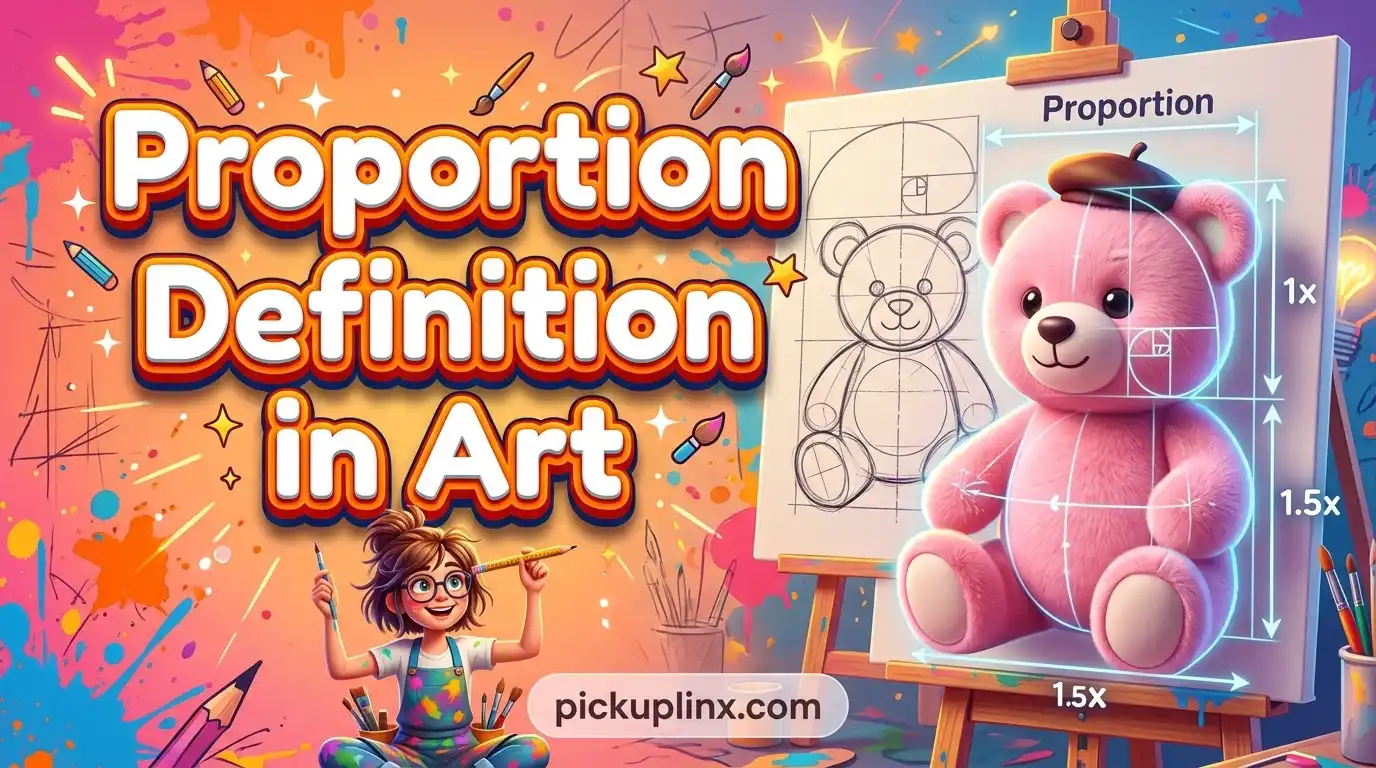
Proportion Definition in Art refers to the size relationship between different parts of an artwork. It helps artists show how large or small one object is compared with another. For example, an artist may draw a person’s head, arms, and body in sizes that look natural and balanced.
Proportion also helps show distance, importance, and style. Artists can use realistic sizes or change them to create a special effect. This principle plays an important role in drawing, painting, sculpture, and design. Understanding proportion in art helps viewers see how objects relate and how artists guide the eye.
1. What Is the Proportion Definition in Art?
The proportion definition in art describes how the sizes of different parts relate to each other and to the whole artwork. It helps artists decide how large, small, long, or short each part should appear.
For example, when drawing a human face, an artist must consider the size of the eyes, nose, mouth, and head. If these parts have suitable size relationships, the face may look natural. If one part is much larger than expected, the image may look unusual or express a special idea.
Proportion is not only about making things look realistic. Artists can also change the size of parts on purpose. A cartoon artist may draw a character with a very large head and a small body to make the character look funny or cute.
In painting, proportion can help show the relationship between people, buildings, trees, and other objects. In sculpture, it helps artists shape figures and forms. In design, it helps create a clear relationship between text, images, and empty space.
In simple words, proportion is about how the sizes of parts fit together. It helps an artist create a realistic image, a balanced design, or an expressive work of art.
2. Why Is Proportion Important in Art?
Proportion helps artists make choices about size and shape. These choices affect how viewers understand an image.
When the parts of an artwork have clear size relationships, the whole piece may feel more natural and easy to read. A portrait with well-planned features can look lifelike. A still-life painting with a small cup beside a large bowl can show the objects’ relative sizes.
Proportion can also guide attention. An artist may make one figure much larger than others to show that the figure is important. This does not always mean the figure is physically bigger. The change in size may be a visual symbol of power, status, or meaning.
For example, a painter may place a large person in the center of a scene while showing smaller figures around them. This choice can make the central figure stand out.
Proportion also helps with planning. Before adding fine details, artists often decide how large each main shape should be. This step can prevent problems later.
The main benefits of proportion include:
- Realism: It helps objects look true to life.
- Balance: It supports a clear relationship between parts.
- Focus: It can draw attention to important details.
- Expression: It allows artists to change sizes for a purpose.
- Unity: It helps separate parts work as one whole.
Good proportion does not always mean exact or natural size. The best choice depends on the artist’s goal.
3. What Is the Difference Between Proportion and Scale?
Proportion and scale are closely linked, but they describe different ideas.
Proportion refers to the size relationship between parts of an object or artwork. Scale refers to the size of an object in relation to another object, a known measure, or the viewer.
For example, imagine drawing a person. If the head is too large compared with the body, the proportions may look unusual. If the entire person is drawn much larger than life size, the scale is large, but the internal proportions may still be realistic.
An artist can also use both ideas together. A huge sculpture may have lifelike proportions, even though its scale is far larger than a real person.
| Feature | Proportion | Scale |
|---|---|---|
| Main meaning | Size relationship between parts | Size in relation to a reference |
| Common question | Do the parts fit together? | How large or small is the whole? |
| Example | Head size compared with body size | A statue twice human height |
| Main use | Structure and visual relationships | Size, impact, and comparison |
Think of a drawing of a small house. If the doors, windows, roof, and walls relate well to one another, the house has good proportions. If the artist makes the whole house tiny on the page, that is a choice of scale.
Knowing the difference helps artists plan images with greater care.
4. Types of Proportion in Art
Artists use proportion in different ways. The type they choose depends on the subject, style, and message of the artwork.
Natural proportion refers to size relationships based on how objects or living things appear in real life. Artists often use observation to study these relationships.
Ideal proportion uses a planned set of relationships to create a form that seems balanced or beautiful. Some artists use ideal proportions when drawing the human body or designing buildings.
Exaggerated proportion changes the size of one or more parts to create emphasis, humor, or emotion. Cartoon characters often use this method.
Symbolic proportion changes size to show meaning or importance. In some artworks, a ruler or sacred figure may appear much larger than other people, even when they are shown in the same scene.
Relative proportion compares one part with another. For example, an artist may study the width of a vase in relation to its height.
These types can overlap. A painter may use natural proportions for a face but exaggerate the size of the hands to show emotion or movement.
There is no single rule for every artwork. Artists choose the type of proportion that best supports their purpose.
5. Proportion in Drawing the Human Body
The human body is one of the clearest examples of proportion in art. Artists must study how the head, torso, arms, legs, hands, and feet relate to one another.
When drawing a person, beginners often make the head too large or the legs too short. These mistakes can happen when artists focus on each body part alone instead of comparing it with the whole figure.
A common method is to use the head as a unit of measurement. Artists estimate how many head lengths fit into the full height of the figure. The result depends on the person, age, pose, and drawing style. It is a guide, not a fixed rule.
For example, a young child usually has a larger head in relation to the body than an adult. A tall adult and a shorter adult may also have different body proportions.
Artists can improve their skills by:
- Looking at the whole figure before drawing details.
- Comparing the width of the shoulders with the head.
- Checking the length of the arms and legs.
- Studying how the body changes in different poses.
- Using simple shapes to plan the figure.
In realistic art, careful observation is often more useful than memorizing one set of measurements. In cartoon art, the artist may change body proportions to create a clear style.
The aim is to make deliberate choices. Even an unrealistic figure can work well if its proportions support the intended look.
6. Proportion in Painting and Composition
In painting, proportion affects how objects relate to each other within the picture. It helps the artist create a clear scene and control the viewer’s attention.
Imagine a still-life painting with an apple, a bottle, and a bowl. If the apple is painted much larger than the bottle without a clear reason, the scene may look odd. If the sizes match what the artist sees, the objects may feel more believable.
Proportion also helps create visual balance. A large object on one side of a painting may be balanced by several smaller objects on the other side. The parts do not need to be equal in size, but their relationships should support the composition.
Artists can use proportion to show depth, too. Objects farther away often appear smaller in a picture. This effect is linked to perspective, which helps create the appearance of three-dimensional space on a flat surface.
However, proportion and perspective are not the same. Proportion concerns size relationships, while perspective explains how objects appear to change with distance and viewing angle.
For example, a painter may place a small house far in the background and a large tree in the foreground. The difference in apparent size helps the viewer read the scene as a space with depth.
Good planning helps the objects feel connected rather than randomly placed.
7. Proportion in Sculpture and Architecture
Proportion is important in both sculpture and architecture because these art forms involve physical size and shape.
In sculpture, artists consider the relationship between parts of a figure or object. A statue of a person needs a clear relationship between the head, torso, arms, and legs if the goal is realism.
Some sculptures use exaggerated proportions for artistic effect. A figure with an unusually large head or hands may draw attention to thought, work, or emotion. The size change can help express an idea.
In architecture, proportion refers to the relationships between parts of a building. These parts may include doors, windows, walls, columns, roofs, and open spaces.
For example, a very small door on a huge wall may look unusual unless the design calls for that effect. A building with windows that relate well to the wall and each other may feel more unified.
Architects and designers may use repeated measurements or geometric systems to guide their work. Yet good design does not depend on one universal ratio. The building’s purpose, materials, setting, and style all matter.
Proportion also affects how people experience a space. A room with a very low ceiling may feel different from a room with a high ceiling. A wide entrance can make a building seem open and welcoming.
In both sculpture and architecture, proportion connects individual parts to the complete form.
8. The Golden Ratio and Proportion in Art
The golden ratio is a mathematical relationship often linked to art, design, and architecture. Its approximate value is 1.618 to 1.
It describes a relationship between two lengths in which the ratio of the whole length to the longer part equals the ratio of the longer part to the shorter part.
Artists and designers may use this relationship to plan layouts, arrange shapes, or explore visual balance. It is also linked to the golden rectangle and certain spiral designs.
For example, a designer may divide a page into sections using the golden ratio to explore where a title, image, or key feature could sit. This can be a useful starting point for composition.
However, the golden ratio is not a rule that every successful artwork must follow. Claims that it explains all beauty in famous paintings or buildings are often overstated. Many artists use other systems, personal judgment, observation, or simple trial and error.
It is also important to separate mathematical proportion from artistic success. A design may follow a precise ratio but still feel awkward if its colors, shapes, or subject matter do not work well together.
The golden ratio is best understood as one possible tool. It can help artists explore relationships, but it does not replace careful observation or creative judgment.
9. Common Proportion Mistakes and How to Fix Them
Proportion mistakes often happen when an artist draws details before checking the main shapes. A small error in the early stages can affect the whole image.
One common mistake is making one part too large or too small. In a portrait, the eyes may be placed too high, or the nose may be too long. In a landscape, a house may be too large compared with nearby trees.
Another problem is failing to compare shapes. An artist may draw a hand by itself without checking how it relates to the arm. The hand may then look too small or too large.
Here are useful ways to improve:
- Start with basic shapes: Use circles, boxes, and simple lines to map the main forms.
- Compare sizes: Check the height, width, and length of nearby objects.
- Look at the whole image: Step back and review the work from a distance.
- Measure with a guide: Use a pencil or grid to compare visible lengths.
- Check negative space: Look at the shapes between objects, not only the objects themselves.
- Make early changes: Correct large errors before adding small details.
For example, if a drawn chair looks too tall beside a table, compare the seat height with the table top and the chair back with the full table height. Adjusting these relationships may make the scene feel more natural.
Practice also matters. Drawing from real objects, photographs, and live models helps train the eye to notice size differences.
10. How to Practice Proportion in Art
You do not need expensive tools to learn proportion. A pencil, paper, and a few simple objects are enough to begin.
Start with a still-life setup. Place a cup beside a book or a bottle beside a bowl. Draw the main shapes before adding details. Compare the height and width of each object and check how they relate to one another.
Next, try drawing a person from a reference image. Begin with the overall height and pose. Then estimate the size of the head, torso, and limbs. Review the figure as a whole before refining the face or clothing.
You can also use a grid. Divide a reference image into equal squares and copy the main shapes into matching squares on your paper. This can help you judge where forms begin and end.
Try these practice tasks:
- Draw three objects of different sizes on one page.
- Sketch the same object from two viewing angles.
- Draw a simple face and compare the sizes of its features.
- Create a cartoon character with exaggerated proportions.
- Redraw one sketch after checking the size relationships.
Keep your first drawings. They can help you see how your observation improves over time.
Most importantly, decide what you want the artwork to achieve. Realistic drawing needs careful observation, while expressive art may call for unusual size relationships. Learning proportion gives you more control over both approaches.
People Also Ask About Proportion Definition in Art
1. What does proportion mean in art?
Proportion in art means the size relationship between different parts of an artwork. It helps artists create realistic forms, balanced compositions, or deliberate visual effects.
2. What is an example of proportion in art?
A portrait is one example. The artist compares the size of the head, eyes, nose, and mouth to create a face that looks realistic or expresses a chosen style.
3. Why is proportion important in art?
Proportion helps objects and figures look connected. It can support realism, balance, visual focus, and clear communication of an idea.
4. What is the difference between proportion and scale in art?
Proportion describes how parts relate in size. Scale describes the size of an object in relation to a reference, such as a person, another object, or real-world measurements.
5. What are the types of proportion in art?
Common types include natural, ideal, exaggerated, symbolic, and relative proportion. Artists use them to create realistic forms, express ideas, or guide attention.
6. What is the golden ratio in art?
The golden ratio is a mathematical relationship of about 1.618 to 1. Artists and designers may use it to plan layouts and explore visual balance, but it is not required for good art.
7. How can beginners improve proportion in drawing?
Beginners can practice by drawing simple objects, comparing heights and widths, using basic shapes, and checking the whole image before adding details. Regular observation helps build accuracy.
Conclusion
The proportion definition in art refers to the size relationships between parts of an artwork and the whole. It helps artists create realistic figures, balanced paintings, expressive sculptures, and thoughtful designs. Proportion can follow natural measurements or change to show emotion, importance, or a unique style.
By comparing shapes, observing real objects, and practicing simple sketches, beginners can improve their skills over time. Understanding proportion gives artists greater control over how viewers see and understand their work.

Julian Lovett – A passionate writer who shares charming pickup lines, romantic ideas, and fun love content to help people spark connections and smiles. ❤️