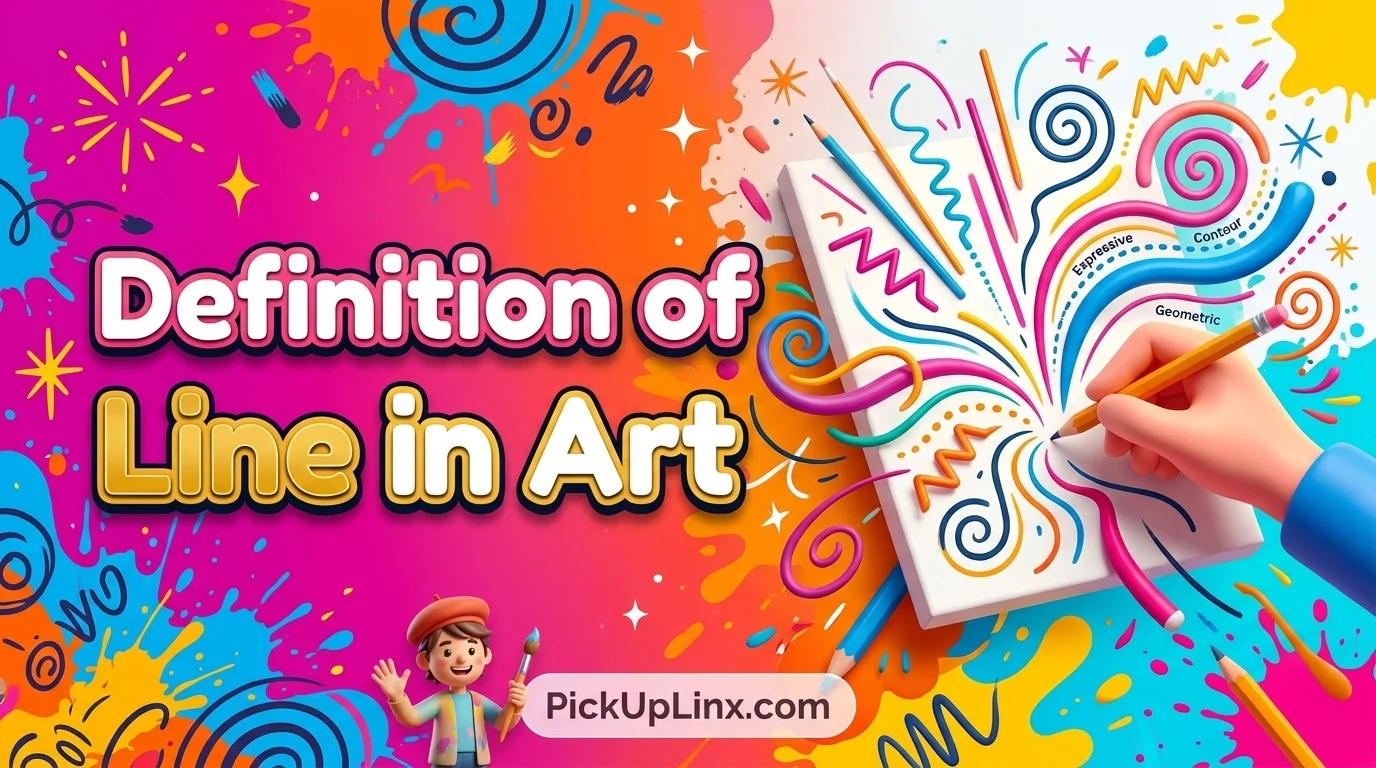
The definition of line in art refers to a mark that connects two or more points or shows a path across a surface. Artists use lines to draw shapes, show movement, create texture, and express feelings. A line can be straight, curved, thick, thin, broken, or wavy. It may outline an object or stand alone as an artwork.
Lines are one of the basic elements of art because they help artists build images and share ideas. From a simple pencil sketch to a detailed painting, lines guide the viewer’s eyes and give meaning to visual work.
1. What Is the Definition of Line in Art?
A line in art is a basic visual element made by a moving point. It can be drawn with a pencil, pen, brush, or other tool. It can also appear through digital drawing, printmaking, and other art forms.
In simple words, a line is a mark that moves across a surface. It may show the edge of an object, divide space, or lead the viewer’s eyes in a certain direction.
For example, an artist may use a curved line to draw a smiling mouth. A straight line may show the edge of a table, while a series of short lines may represent grass.
Lines do not always need to outline real objects. They can also express feelings, ideas, and movement. A sharp zigzag line may suggest energy or tension. A soft, flowing line may create a calm and gentle mood.
Artists use lines in many ways, depending on what they want to show. Even a simple line can change how a drawing looks and feels.
Read more [Caricature Definition]
2. Why Is Line an Important Element of Art?
Line is one of the seven basic elements of art, along with shape, form, color, value, texture, and space. These elements help artists organize visual ideas and create meaningful work.
Lines often form the starting point of a drawing. Before adding color or shading, an artist may use lines to plan the position and size of objects.
Lines also help viewers understand what they see. They can show where one object ends and another begins. They may guide the eye toward an important part of a picture.
Here are some key uses of line in art:
- Outlining: Showing the edges of people, animals, and objects.
- Movement: Leading the eye across a picture.
- Texture: Suggesting hair, grass, wood, or fabric.
- Depth: Helping create the feeling of distance.
- Expression: Sharing moods such as calmness, excitement, or fear.
- Structure: Organizing shapes and spaces within an artwork.
For example, a landscape artist might use long horizontal lines to show a quiet lake. Short, uneven lines could represent rough rocks along its edge.
Without lines, many pictures would lose their structure and detail. Lines help artists turn simple marks into clear visual messages.
3. What Are the Different Types of Lines in Art?
Artists use many types of lines to create different effects. Each type can change the look, mood, and meaning of an artwork.
Horizontal lines move from side to side. They often suggest rest, peace, or stability.
Vertical lines move up and down. They may show strength, height, or power. Artists often use them to draw trees, buildings, and standing figures.
Diagonal lines move at an angle. They can suggest action, speed, or change because they feel less stable than horizontal lines.
Curved lines bend smoothly. They can create a soft, flowing look and are common in drawings of faces, plants, and human bodies.
Zigzag lines change direction through sharp turns. They often suggest energy, danger, or excitement.
Wavy lines rise and fall in a gentle pattern. They can represent water, wind, or flowing hair.
Broken lines contain gaps. They may suggest movement, loose shapes, or an incomplete form.
Artists may combine several line types in one artwork. For instance, a drawing of a storm could include diagonal rain, curved clouds, and jagged lightning.
The choice depends on the subject and the effect the artist wants to create.
4. How Do Lines Create Shape and Form?
Lines help artists show the outlines and structure of objects. A shape is a flat, enclosed area, while form gives an object the appearance of being three-dimensional.
For example, an artist can draw a circle using a curved line. The circle may represent a ball, a plate, or the sun. Adding shading and curved marks can make that flat circle look like a round sphere.
Lines also help show the structure of more complex objects. An artist drawing a house may use straight lines for walls, diagonal lines for the roof, and small lines for windows and doors.
In figure drawing, artists often begin with simple lines to show the position of the head, spine, arms, and legs. These marks help establish the body’s pose before details are added.
Lines can also overlap to create a sense of depth. Objects with clear edges may appear closer, while lighter or less detailed lines can make distant objects seem farther away.
For example, in a drawing of a road, two diagonal lines may appear to meet in the distance. This creates the impression that the road stretches away from the viewer.
Through careful placement, lines help turn basic marks into recognizable objects and believable forms.
5. What Is Line Quality in Art?
Line quality describes how a line looks and feels. It includes its thickness, darkness, smoothness, and overall character.
Two lines can have the same shape but create very different effects. A dark, thick line may look bold and strong. A thin, light line may seem soft and delicate.
Artists change line quality to add contrast and guide attention. They may press harder with a pencil to make a dark mark or use less pressure for a faint one.
Common features of line quality include:
- Weight: How thick or thin a line appears.
- Value: How light or dark it looks.
- Texture: Whether it appears smooth, rough, or uneven.
- Continuity: Whether it is solid, broken, or dotted.
- Direction: The way it travels across the surface.
Consider a drawing of a tree. Thick, dark lines may show the trunk, while thin, short marks can suggest small branches and leaves.
Changing line quality can also show distance. Strong, clear outlines may bring an object forward, while faint lines can make background details seem less important.
Line quality gives artists more control over how viewers read an image. It helps a simple outline become expressive and full of detail.
6. How Do Lines Show Mood and Emotion?
Lines can communicate feelings even when an artwork has no words. Their direction, shape, and quality can affect how viewers respond to an image.
Horizontal lines often create a feeling of calm because they remind us of still water or a flat horizon.
Vertical lines can suggest strength and dignity. Tall trees and large buildings often use this effect.
Diagonal lines may create tension or movement. They can make a picture feel active or unbalanced.
Curved lines often feel gentle, natural, or graceful. Artists use them to show flowing hair, flowers, and relaxed body movements.
Jagged lines may suggest fear, anger, or danger. Their sharp changes in direction can make an image feel restless.
These meanings are not fixed rules. Culture, subject, color, and personal experience can change how people understand a line.
For example, an artist creating a peaceful scene may draw long, smooth curves and quiet horizontal marks. An artist showing a busy city may use sharp angles, crossing lines, and varied line weights.
Line can also express emotion through speed. Quick, loose marks may look excited or spontaneous, while slow, careful lines may feel controlled.
Artists use these effects to make visual work more expressive. Viewers may sense a mood before they fully understand the scene.
7. What Is the Difference Between Outline, Contour, and Gesture Lines?
The terms outline, contour line, and gesture line are related, but they serve different purposes in art.
An outline marks the outer edge of a shape. It helps separate an object from the background.
A contour line follows the visible edges of an object. It can also show changes across a surface, helping describe the object’s shape and structure.
A gesture line is a quick, loose mark used to capture the action, direction, or energy of a subject. Artists often use gesture drawing to plan a pose before adding details.
| Line type | Main purpose | Example |
|---|---|---|
| Outline | Shows the outer edge | Drawing the border of a cup |
| Contour line | Describes shape and surface | Showing the curve of an apple |
| Gesture line | Captures movement or pose | Sketching a person running |
| Construction line | Helps plan proportions | Marking the main parts of a face |
| Hatching line | Builds tone and shadow | Shading one side of a box |
Imagine drawing a person sitting on a chair. A gesture line may first show the direction of the spine and legs. Contour lines can then describe the arms and clothing. An outline may help define the person’s overall shape.
These methods can work together in a single drawing. Learning when to use each one helps artists create clearer and more natural images.
8. How Do Artists Use Lines to Create Texture and Shading?
Lines can make a flat surface appear rough, soft, smooth, or detailed. Artists use repeated marks to suggest how an object might feel if touched.
For example, short, uneven lines can represent the rough bark of a tree. Long, smooth curves may show the soft flow of a ribbon. Fine marks can suggest the fur of an animal.
One common method is hatching. This involves drawing a group of parallel lines to create tone or shadow. The closer the lines are, the darker an area may appear.
Cross-hatching uses two or more sets of crossing lines. This method can create deeper shadows and richer detail.
Artists can also use curved lines to follow the shape of an object. Curved marks around a ball may help show its round surface, while straight marks along a box can support its solid form.
The spacing and pressure of the marks matter. Closely packed, dark lines often create a heavier shadow. Widely spaced, light lines may suggest a brighter area.
For example, a pencil drawing of a metal spoon may use smooth lines and gentle shading. A drawing of a stone wall may use broken, rough marks to suggest uneven surfaces.
These techniques help artists add depth and texture without relying on color alone.
9. Examples of Line in Different Art Forms
Lines appear in almost every form of visual art. Their role changes depending on the medium, subject, and purpose.
Drawing: Pencil and ink artists use lines to build outlines, details, shadows, and patterns. A simple line drawing can show a face with only a few carefully placed marks.
Painting: Painters use brushstrokes to create visible lines. These may define shapes, add detail, or become part of the painting’s style.
Sculpture: Lines can appear through grooves, raised edges, and the direction of a sculpture’s form. They may guide the eye around the object.
Printmaking: Artists carve or draw lines into a surface to create patterns and images. The lines transfer to paper during printing.
Digital art: Drawing programs allow artists to change line thickness, color, smoothness, and direction. This makes it easy to test different styles.
Architecture: Lines help define the edges of buildings, windows, roofs, and structural parts. Repeated vertical and horizontal lines can create a sense of order.
Abstract art: Artists may use lines without drawing recognizable objects. A group of bold, curved, or intersecting marks can express rhythm, tension, or emotion.
For example, a cartoon artist may use thick outlines to make a character easy to recognize. An abstract artist may use thin, crossing lines to explore movement and space.
These examples show that lines are not limited to drawing. They are a flexible tool for planning, building, and expressing visual ideas.
Read more [Franchisor Definition]
10. Simple Ways to Practice Line in Art
Learning to use lines well begins with practice. You do not need costly tools or advanced skills. A pencil, paper, and a little time are enough to get started.
Try these exercises:
- Draw straight lines: Make horizontal, vertical, and diagonal marks. Focus on control rather than perfection.
- Practice curves: Draw circles, waves, spirals, and long flowing curves.
- Change line weight: Press lightly, then firmly, to see how the marks change.
- Create a line pattern: Repeat lines with different spaces and directions.
- Draw an object: Choose a cup, leaf, or shoe and sketch its main edges.
- Try gesture drawing: Make quick marks to capture the pose of a person or animal.
- Add texture: Use short lines to suggest fur, wood, grass, or stone.
You can also draw the same object in two different ways. First, use only thin lines. Then redraw it with a mix of thick, thin, dark, and light marks.
Compare the results. Notice which version looks stronger, softer, or more detailed.
Do not worry if your first attempts look uneven. Regular practice helps improve hand control and observation. The goal is to understand how different marks work, not to make every line perfect.
As you gain skill, you will learn to choose lines that fit your subject and express your own ideas.
People Also Ask About Definition of Line in Art
1. What is a line in art in simple words?
A line in art is a mark that moves across a surface. Artists use it to show edges, shapes, movement, texture, and emotion.
2. What are the seven elements of art?
The seven elements of art are line, shape, form, color, value, texture, and space. Artists use them to create and organize visual work.
3. What are the five basic types of lines in art?
Five common types are horizontal, vertical, diagonal, curved, and zigzag lines. Artists also use wavy, broken, dotted, and other line styles.
4. Why is line important in drawing?
Line helps artists create outlines, plan shapes, show movement, add details, and build shadows. It is often one of the first tools used when making a drawing.
5. What is line quality in art?
Line quality describes the appearance of a line, including its weight, darkness, smoothness, texture, and continuity. Different qualities create different visual effects.
6. Can a line show emotion?
Yes. Smooth curves may suggest calmness, while sharp zigzags can create tension or energy. The meaning depends on the artwork and how viewers interpret it.
7. What is the difference between line and shape in art?
A line is a mark or path. A shape is an enclosed, flat area, such as a circle or square. Lines often form the boundaries of shapes.
Conclusion
The definition of line in art explains one of the most basic tools artists use to create images and share ideas. Lines can outline objects, build shapes, show movement, create texture, and express emotion. Their direction, thickness, and quality can change the mood of an artwork.
From simple pencil sketches to paintings and digital designs, lines help organize visual information and guide the viewer’s eyes. By learning about different line types and practicing simple drawing exercises, beginners can build strong art skills and develop a better understanding of how visual images work.

Julian Lovett – A passionate writer who shares charming pickup lines, romantic ideas, and fun love content to help people spark connections and smiles. ❤️