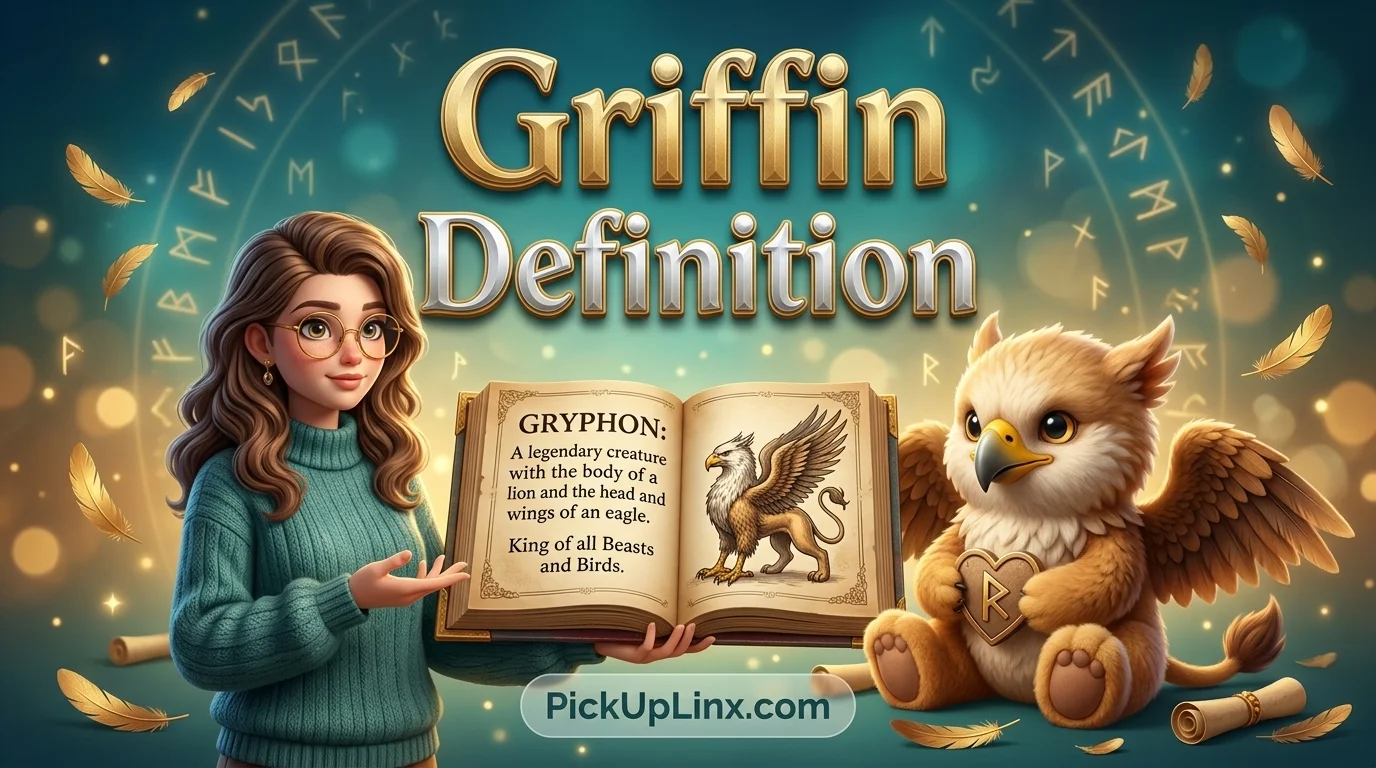
A griffin is a legendary creature with the body of a lion and the head, wings, and sharp beak of an eagle. It appears in ancient myths, art, stories, and heraldry. The griffin is often linked with strength, courage, power, and protection. In many old tales, it guards valuable treasures or sacred places.
The creature has roots in ancient cultures and became a lasting symbol across Europe and Asia. Today, the griffin still appears in books, games, movies, logos, statues, and fantasy art. Understanding the griffin definition helps explain why this unusual creature has remained popular for thousands of years.
1. What Is the Definition of Griffin?
The griffin is a mythical creature that combines features of two powerful animals: the lion and the eagle.
A traditional griffin has the body, legs, and tail of a lion. Its head, wings, and front talons resemble those of an eagle. Some artistic versions also show eagle-like feathers across parts of the body.
The word can also be spelled griffin, gryphon, or griffon. These forms can refer to the same legendary creature, although spelling preferences vary by period, language, and source.
In simple terms, a griffin is a lion-eagle creature from mythology.
The combination is meaningful. The lion was seen as a powerful land animal, while the eagle was associated with the sky, vision, and strength. Bringing these two animals together created a creature that represented extraordinary power.
2. What Does Griffin Mean?
The meaning of griffin goes beyond its physical appearance.
In traditional stories, the creature often represents strength, bravery, guardianship, and authority. Its lion body suggests courage and physical power. Its eagle features suggest speed, sharp sight, and connection with the heavens.
This combination made the griffin an impressive symbol.
For example, a story might describe a griffin guarding a golden treasure. The creature is not simply a monster standing near the treasure. Its role shows that the treasure is precious and protected by a powerful guardian.
The meaning can change depending on the context. In mythology, it may be a guardian. In heraldry, it can represent courage or strength. Modern fantasy, it may be shown as a magical animal that can fly and carry people.
So, the griffin definition depends partly on how and where the creature is used.
3. What Does a Griffin Look Like?
A classic griffin combines the most recognizable features of a lion and an eagle.
| Feature | Traditional Griffin |
|---|---|
| Head | Eagle-like |
| Beak | Sharp and curved |
| Body | Lion-like |
| Front legs | Often eagle-like |
| Back legs | Lion-like |
| Wings | Large, feathered wings |
| Tail | Usually lion-like |
| Main idea | Combination of land and sky |
Artwork can differ. Some griffins have large eagle talons on all four legs, while others have lion-like hind legs and bird-like front legs.
The creature is usually shown with a strong body and large wings. Artists often make it look proud, alert, and powerful.
Its appearance is one reason it is easy to recognize. Even when the style changes, the basic lion-and-eagle combination usually remains.
4. Where Did the Griffin Come From?
The griffin has a very old history. Images of griffin-like creatures appeared in ancient art long before the creature became common in later European fantasy.
Griffin-like figures have been found in the art of ancient cultures across parts of the Near East and surrounding regions. The creature later became well known in the ancient Greek world.
Greek writers and artists described or pictured griffins as unusual creatures connected with distant lands. Ancient stories sometimes placed them in remote areas beyond the familiar Greek world.
The exact origin of the griffin is complex. There was not one single moment when someone invented the creature. Similar winged animal figures appeared in different cultures over long periods.
This is important when studying mythology. A modern fantasy griffin may look familiar, but its history reaches much further back than today’s books, games, and movies.
5. Griffin in Greek Mythology
The griffin became an important creature in Greek mythology and art.
Ancient Greek sources connected griffins with remote northern regions and with stories about gold. Some accounts described them as guardians of valuable treasures.
One famous tradition connected griffins with the gold of the Arimaspians, a legendary people said to live far away. In these stories, griffins guarded gold while the Arimaspians tried to take it.
Not every ancient story gives the griffin exactly the same role. Mythology often changes from one writer or period to another.
The creature also appeared in Greek artwork, pottery, decorative objects, and sculpture. Its unusual shape made it useful as a symbol of power and mystery.
The Greek tradition helped spread the griffin’s image and influenced how later cultures understood the creature.
6. Griffin Symbolism and Meaning
The griffin carries several symbolic meanings.
The strongest is power. A lion was already a symbol of strength, while an eagle was viewed as a powerful bird with an impressive ability to fly high. Combining them created an even stronger image.
Common griffin meanings include:
- Strength and physical power
- Courage in difficult situations
- Protection of people or valuable things
- Vigilance and sharp awareness
- Authority and leadership
- Freedom through its ability to fly
- Guardianship of sacred or precious objects
The griffin can also symbolize the joining of two worlds. The lion belongs to the land, while the eagle belongs to the sky.
Because of this, the creature is sometimes viewed as a bridge between earth and heaven.
Its symbolism is not fixed, though. Different cultures and works may give it different meanings.
7. Griffin in Heraldry
The griffin became an important figure in heraldry, the traditional system of symbols used on shields, coats of arms, flags, and related designs.
In heraldic art, the creature is often shown standing on its hind legs with its wings raised. Its eagle head and lion body make it visually striking.
A griffin on a coat of arms may suggest qualities such as:
- Courage
- Strength
- Protection
- Determination
- Military power
- Nobility
Heraldic designs are highly stylized, so a griffin on a shield may look different from a griffin in a fantasy novel.
Its use in heraldry helped keep the creature’s image alive for centuries. Even people who did not know the old myths could recognize the griffin as a powerful symbolic figure.
8. Griffin vs. Other Mythical Creatures
The griffin is sometimes confused with other legendary creatures because many myths contain animals with wings, horns, or mixed bodies.
A griffin is mainly defined by its lion-and-eagle form. Other creatures have different combinations.
For example, a hippogriff usually has the front half of an eagle and the back half of a horse. A dragon may have wings, scales, claws, and a long reptile-like body. A sphinx traditionally combines a human head with a lion’s body.
Here is a quick comparison:
| Creature | Main Features | Common Association |
|---|---|---|
| Griffin | Lion + eagle | Strength and protection |
| Hippogriff | Eagle + horse | Fantasy and freedom |
| Dragon | Reptile-like body, often wings | Power and magic |
| Sphinx | Human head + lion body | Riddles and mystery |
| Phoenix | Magical bird | Rebirth and renewal |
These creatures may share some traits, but their traditional forms and meanings are different.
9. Griffin in Modern Culture
The griffin is still popular today.
Modern fantasy has made the creature familiar to new generations. Griffins appear in fantasy novels, video games, films, television shows, trading cards, artwork, and role-playing games.
Modern stories may change the traditional idea. A griffin can be presented as a wild beast, a loyal companion, a magical mount, or a guardian.
Some fictional versions are friendly and intelligent. Others are dangerous and difficult to control.
This flexibility makes the creature useful for storytelling. Its basic appearance is already memorable, so writers can give it new personalities without losing its identity.
You may also see griffins in:
- Fantasy game characters
- Sports and school mascots
- Company and organization symbols
- Book illustrations
- Jewelry and decorative art
- Statues and architecture
- Fictional maps and world-building
The continued use of the griffin shows how an ancient mythical image can adapt to modern culture.
10. Examples of Griffin in a Sentence
Understanding a word is easier when you see it in context.
Here are some simple examples:
- The griffin guarded the ancient treasure.
- A golden griffin appeared on the warrior’s shield.
- The fantasy story described a griffin flying over the mountains.
- The museum displayed an ancient image of a griffin.
- The castle had a stone griffin above its main gate.
- The young hero hoped to ride a griffin one day.
- The griffin became a symbol of strength and courage.
The word is normally used as a noun because it names a creature.
For example, you can say, “The griffin flew across the valley.”
You can also use the word when discussing mythology, art, history, fantasy, or symbolism.
Griffin Definition in Simple Words
If you need the shortest possible explanation, remember this:
A griffin is a mythical creature with the body of a lion and the head and wings of an eagle.
That simple definition covers its most important identifying features.
People Also Ask About Griffin Definition
What is a griffin in simple terms?
A griffin is a legendary creature that combines a lion and an eagle. It usually has a lion’s body with an eagle’s head, wings, and front claws.
Is a griffin a real animal?
No. A griffin is a mythical creature, not a real animal. It comes from ancient stories, art, and symbolic traditions.
What does a griffin symbolize?
A griffin commonly symbolizes strength, courage, protection, power, and guardianship. Its meaning can change depending on the culture or story.
Is a griffin a lion or an eagle?
A griffin is neither a real lion nor an eagle. It is a mythical combination of both animals, usually showing a lion’s body and eagle-like head and wings.
Where did the griffin originate?
Griffin-like creatures appeared in ancient art from several regions. The figure later became well known in Greek mythology and art, where it was linked with distant lands and stories about gold.
What is the difference between a griffin and a hippogriff?
A griffin combines a lion and an eagle. A hippogriff traditionally combines an eagle’s front half with a horse’s back half. They are separate mythical creatures.
Why did ancient people use griffin symbols?
The griffin’s combination of a powerful lion and a strong eagle made it a useful symbol of power, protection, courage, and authority. It was also visually distinctive in art and decoration.
Conclusion
The griffin is one of the most recognizable creatures in mythology. With the body of a lion and the head and wings of an eagle, it combines the power of land and sky into one legendary figure. Ancient cultures used griffin-like images long ago, while Greek traditions helped shape the creature’s familiar identity.
Over time, it became a symbol of strength, courage, protection, and guardianship. Today, griffins remain popular in heraldry, fantasy stories, games, art, and popular culture. Whether you meet one in an ancient artifact or a modern fantasy world, its powerful lion-and-eagle form makes its meaning easy to remember.

Julian Lovett – A passionate writer who shares charming pickup lines, romantic ideas, and fun love content to help people spark connections and smiles. ❤️