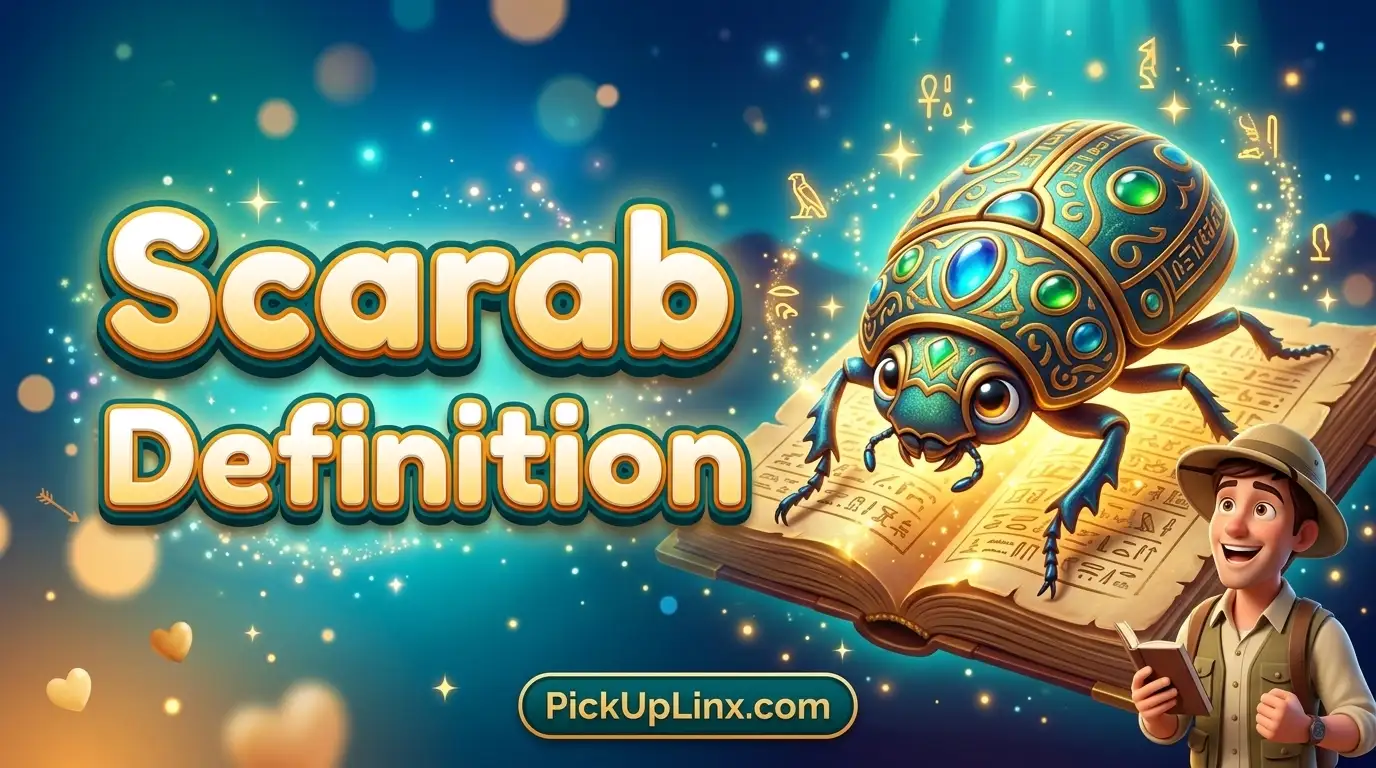
A Scarab Definition is a type of beetle best known for its role in ancient Egyptian culture. Many scarabs belong to the scarab beetle family, which includes insects that feed on dung, plants, or other organic matter. In ancient Egypt, the scarab became a powerful symbol of life, rebirth, protection, and the rising sun.
People made small scarab-shaped objects from stone, clay, and other materials. These items often served as jewelry, seals, or religious charms. Understanding the scarab definition helps explain both the insect’s place in nature and its lasting importance in history, art, and ancient beliefs.
1. What Is the Definition of a Scarab?
The word scarab refers to a beetle of the scarab group, especially one associated with ancient Egyptian art and religion. Scarab beetles belong to the family Scarabaeidae, a large group of insects with many different species.
In everyday use, the word often brings to mind the sacred scarab of ancient Egypt. This beetle was linked to the sun, creation, and the cycle of life. Egyptians also made objects shaped like the insect, often using them as jewelry, seals, and protective charms.
The term can therefore have two main meanings:
- A living insect: A beetle belonging to the scarab group.
- A historical object: A carved item shaped like a scarab beetle, often used in ancient Egyptian culture.
For example, a natural history book may describe a scarab beetle found in a garden. An archaeology book may describe a carved scarab found in an Egyptian tomb.
Both uses are correct, but the meaning depends on the context. The insect is part of the natural world, while the carved scarab is an important part of human history and culture.
2. What Does a Scarab Beetle Look Like?
Scarab beetles come in many shapes, sizes, and colors. Some have shiny black or brown bodies, while others may appear green, gold, or brightly colored. Their bodies are usually strong and oval-shaped.
Like other beetles, scarabs have a hard outer covering that protects their wings and body. They have six legs, two antennae, and a pair of front wings that form a protective cover over the flying wings.
Many species have a rounded back. Some have horns or raised shapes on their heads or bodies. These features can help identify certain species, especially male beetles.
Common features of scarab beetles include:
- A hard outer body covering.
- Six jointed legs.
- Antennae that help detect smells and other signals.
- Front wings that protect the flying wings.
- Strong legs suited to digging in soil or moving food.
Not all scarabs look alike. A small dung beetle may look very different from a large, colorful flower chafer. The word scarab describes a broad group rather than one single species.
This variety makes scarab beetles interesting to scientists and nature lovers. Their body shapes and habits also help them survive in many environments.
3. What Is the Meaning of a Scarab in Ancient Egypt?
In ancient Egypt, the scarab held deep religious meaning. It was closely linked to Khepri, a god often shown as a scarab beetle or a human figure with a scarab head. Khepri was associated with the rising sun and the idea of becoming or coming into existence.
The beetle’s habit of rolling a ball of dung helped inspire this connection. Ancient Egyptians saw a link between this action and the movement of the sun across the sky.
The scarab also became a symbol of renewal. The appearance of young beetles from buried dung balls may have seemed like a sign of new life emerging from the earth.
For these reasons, scarabs appeared in religious art, jewelry, seals, and burial objects. People used them to express ideas about life, protection, and the journey after death.
However, not every scarab had the same purpose. Some were personal ornaments, while others carried names, messages, or religious designs.
The scarab’s importance shows how people can find meaning in the natural world. A small insect became a lasting symbol because its behavior seemed to reflect ideas about the sun, creation, and life beyond death.
4. Why Was the Scarab a Symbol of Rebirth?
The scarab became a symbol of rebirth and renewal because of the beetle’s life cycle and its connection with the sun.
Many dung beetles shape dung into balls and move them to a place where they can feed or lay eggs. In some species, eggs develop inside or near the prepared dung. When young beetles emerge, the process can appear to show new life coming from the earth.
Ancient Egyptians connected this cycle with the daily sunrise. Each morning, the sun appeared again after night, bringing light to the world. The scarab became a symbol of this repeated return.
The idea of renewal was also important in Egyptian burial beliefs. Scarab-shaped objects were placed in tombs to express hope for protection and a new life after death.
A special object called a heart scarab was sometimes placed with a mummy. It was linked to beliefs about judgment in the afterlife and the role of the heart. Some heart scarabs carried spells from the Book of the Dead.
These practices show that the scarab was more than a picture of a beetle. It expressed hope that life could continue and begin again.
5. What Were Scarab Amulets Used For?
A scarab amulet is a small object shaped like a scarab beetle. In ancient Egypt, people wore or carried these objects for several reasons.
Some scarabs were believed to offer protection. Others expressed religious ideas, showed a person’s status, or served as personal items. Their meaning depended on the design, material, and time in which they were made.
Artisans carved scarabs from materials such as stone, faience, and other substances. Faience was a glazed, non-clay material often used to create colorful objects. Some scarabs were also made from precious or semi-precious stones.
Common uses included:
- Jewelry: Scarabs could be worn on rings, necklaces, or other ornaments.
- Protective charms: Some were linked to safety and well-being.
- Seals: Their flat undersides could carry names, images, or official designs.
- Burial objects: Certain scarabs were placed with the dead as part of funerary practices.
- Memorial items: Some commemorated rulers or important events.
For example, a scarab with a name carved underneath might have served as a seal or personal object. A large heart scarab placed in a tomb had a different role tied to beliefs about death and the afterlife.
Not every scarab was a magical charm. Many had practical, personal, or official uses as well.
6. What Is the Difference Between a Scarab and a Dung Beetle?
The terms scarab and dung beetle are closely related, but they do not mean exactly the same thing.
A scarab is a member of a broad beetle group. A dung beetle is a type of beetle known for feeding on dung or using it to raise its young. Many dung beetles belong to the scarab family, but not all scarab beetles depend on dung.
Some scarab species feed on leaves, flowers, fruit, or plant roots. Others play a role in breaking down animal waste.
| Feature | Scarab Beetle | Dung Beetle |
|---|---|---|
| Meaning | Broad group of beetles | Beetles linked to dung |
| Diet | Varies by species | Often dung or material found in it |
| Main role | Depends on the species | Often helps break down waste |
| Appearance | Many shapes and colors | Varies by species |
| Relationship | Includes many kinds of beetles | Many belong to the scarab family |
A flower chafer is an example of a scarab that may feed on flowers or plant material as an adult. A dung beetle may roll or bury dung to feed itself or support its young.
This distinction is useful because the ancient Egyptian scarab symbol was inspired by particular beetles, while the larger scarab group includes many insects with different habits.
7. What Role Do Scarab Beetles Play in Nature?
Scarab beetles play several useful roles in the natural world. Their exact role depends on the species and where it lives.
Many dung beetles help remove animal waste. They may roll it into balls, bury it, or break it into smaller pieces. This process helps return nutrients to the soil and can improve soil structure.
Other scarab beetles feed on plants or flowers. Some help with pollination as they move between blooms. Certain species, however, can damage crops, lawns, or garden plants during part of their life cycle.
Their main ecological roles may include:
- Recycling nutrients: Dung-feeding species help return nutrients to the ground.
- Improving soil: Burrowing beetles can loosen soil and move organic matter below the surface.
- Supporting food webs: Birds, reptiles, and other animals may eat beetles or their young.
- Helping some plants: Flower-visiting species may transfer pollen.
- Affecting plant health: Some grubs feed on roots and may harm lawns or crops.
For example, a dung beetle that buries waste can help reduce the amount left on the ground. A scarab grub that feeds on grass roots may cause brown patches in a lawn.
These differences show why scarab beetles should not all be viewed as helpful or harmful. Their effects depend on the species and the local environment.
8. How Were Scarabs Made and Used in Ancient Art?
Ancient Egyptian artisans made scarabs in many sizes and styles. Some were small enough to wear as jewelry, while others were larger objects used in religious or burial settings.
A typical carved scarab had a rounded top shaped like a beetle. Its underside was often flat, making it suitable for carving names, signs, or short inscriptions.
Materials varied by period and purpose. Artisans used stone, faience, glazed materials, and other substances. The choice of material affected the object’s color, strength, and value.
Scarabs could also serve as seals. When pressed into a soft material, a carved design could leave an impression. This made the object useful for marking goods, documents, or containers.
The designs changed over time. Some showed a natural-looking beetle, while others included religious signs, royal names, or decorative patterns.
Archaeologists study scarabs to learn about ancient Egyptian life. An inscription may help identify a ruler or connect an object with a certain period. The material and carving style can also provide clues, although experts must consider the full archaeological evidence.
Today, scarabs appear in museum collections and books about ancient Egypt. They are valued as examples of the skill, beliefs, and daily practices of the people who made and used them.
9. What Is the Difference Between a Scarab and a Heart Scarab?
A regular scarab and a heart scarab share the same beetle shape, but they may have different sizes, inscriptions, and purposes.
A regular scarab could be worn as jewelry, used as a seal, or kept as an amulet. Some carried personal names or symbols. Others were made mainly for decoration.
A heart scarab was a special funerary object connected with ancient Egyptian beliefs about the heart and the afterlife. It was often larger than an ordinary scarab and could be placed on the chest of a mummy or among the burial items.
Ancient Egyptians believed the heart played an important role in the judgment of the dead. In some funerary texts, a spell associated with the heart scarab asked the heart not to speak against the deceased during judgment.
The two objects can be compared in this way:
| Feature | Regular Scarab | Heart Scarab |
|---|---|---|
| Common use | Jewelry, seals, amulets | Funerary object |
| Size | Often small | Often larger |
| Inscription | Names, designs, or symbols | May include a funerary spell |
| Main context | Daily life and religion | Burial and afterlife beliefs |
These categories can overlap. A scarab might carry religious meaning even if it was not a heart scarab. Its purpose is best understood by looking at its design, inscription, and archaeological setting.
10. What Does a Scarab Symbolize Today?
Today, the scarab remains a well-known symbol of ancient Egypt. It appears in jewelry, artwork, books, museum displays, and popular culture.
Many people associate the scarab with rebirth, transformation, protection, and renewal. These meanings come largely from its place in ancient Egyptian religion and art.
A person may choose scarab jewelry to express a fresh start or an interest in history. An artist may use the beetle’s shape to represent change or the cycle of life. Museums display scarabs to help visitors understand ancient beliefs and craftsmanship.
However, modern meanings can vary. A scarab design does not have one universal message, and not everyone who wears it shares the same beliefs.
It is also important to distinguish modern symbolism from ancient practice. The ancient Egyptians used scarabs within a specific religious and cultural world. Modern fashion and spiritual interpretations may draw on that history but can give the symbol new meanings.
For example, someone beginning a new job may wear a scarab pendant as a personal reminder of growth. A history student may study the same design to learn about ancient burial customs.
In both cases, the object carries meaning, but the reason for using it differs.
People Also Ask About Scarab Definition
1. What is a scarab in simple words?
A scarab is a type of beetle, especially one linked to ancient Egyptian culture. The word can also mean a carved beetle-shaped object used as jewelry, a seal, or an amulet.
2. What did the scarab symbolize in ancient Egypt?
The scarab symbolized rebirth, renewal, protection, and the rising sun. It was linked to Khepri, a deity associated with the sun and the idea of coming into existence.
3. Is a scarab the same as a dung beetle?
Not exactly. Many dung beetles belong to the scarab family, but the scarab group includes other beetles that feed on plants, flowers, and different organic materials.
4. Why did Egyptians put scarabs in tombs?
Some scarabs were placed in tombs as protective or religious objects. Heart scarabs were linked to beliefs about the deceased person’s heart and judgment in the afterlife.
5. Are scarab beetles harmful?
Some species can damage plants or lawns, while others help recycle nutrients and improve soil. Whether a scarab is harmful depends on the species and its behavior.
6. What is a heart scarab?
A heart scarab is an ancient Egyptian funerary object shaped like a beetle. It was linked to the heart’s role in the judgment of the dead and sometimes carried a religious spell.
7. What does a scarab mean in modern jewelry?
In modern jewelry, a scarab may represent renewal, change, protection, or an interest in ancient Egyptian history. Its meaning depends on the person wearing it and the design.
Conclusion
The scarab definition covers both a group of beetles and the carved objects inspired by them. In nature, scarab beetles have many roles, from recycling waste to feeding on plants.
In ancient Egypt, the scarab became a lasting symbol of the rising sun, renewal, and life after death. Artisans turned its shape into jewelry, seals, and funerary objects that still interest historians today. Understanding the scarab helps connect the natural world with the beliefs and art of an ancient civilization.

Julian Lovett – A passionate writer who shares charming pickup lines, romantic ideas, and fun love content to help people spark connections and smiles. ❤️